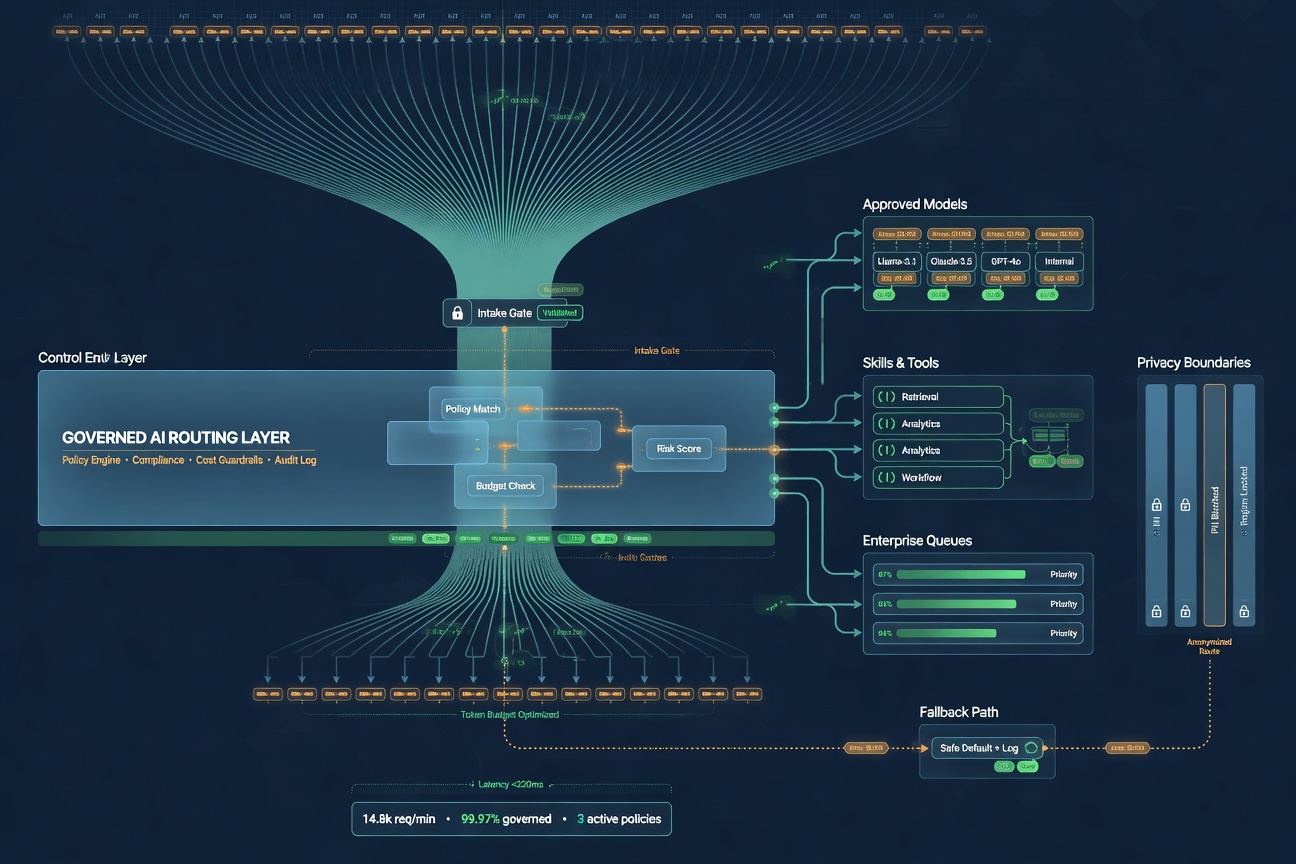
ThinkFreely AI Operating Layer
RouteFreely: AI Routing Engine for Enterprise Workflows
Enterprise AI needs more than model access. It needs routing control that can scale with cost discipline, privacy boundaries, and operational reliability.
What does RouteFreely route on? How does privacy-aware dispatch work?
Why AI Routing Matters
AI adoption often starts with access to a chatbot, a model, or a workflow plugin. That can be enough for early experimentation, but it becomes fragile once AI use spreads across departments, tools, and business processes.
As companies move from AI experimentation to implementation, different requests may require different models, skills, privacy rules, queues, departments, tools, cost profiles, or reliability paths. When every request follows the same oversized route, organizations can overuse expensive models, push unnecessary context, and lose visibility into AI spend.
Without an AI routing engine, that complexity often gets scattered across applications, prompts, permissions, and manual decisions.
Too Many Models
Different models have different strengths, latency profiles, privacy characteristics, availability patterns, and cost implications. Most organizations need a better path than asking every user to understand every option.
Too Many Workflows
Sales, operations, finance, marketing, legal, HR, and support teams may all use AI differently. Each workflow may need its own skills, rules, access boundaries, and approved destinations.
Too Little Control
Without routing logic, AI usage can become fragmented across disconnected tools and inconsistent governance patterns. Leadership may not know what is being used, where sensitive work is going, or whether the right endpoint is handling the request.

RouteFreely gives ThinkFreely a controlled routing layer for enterprise AI implementation. It helps determine where AI work should go, which paths are allowed, what rules apply, how requests should be prioritized, and how approved fallback options should be used when a preferred route is unavailable or unsuitable.
What Is an AI Routing Engine?
An AI routing engine is the operating logic that decides how AI requests should move through an organization’s AI environment.
It helps determine which model, endpoint, skill, queue, tool, or workflow path should handle a request based on factors such as capability, access, privacy requirements, workload priority, availability, cost, and operational policy.
Where should this AI request go, and under what rules?
RouteFreely turns that question into an operating capability inside ThinkFreely.
Model Routing
Direct requests to the model or endpoint best suited to the task, user permissions, cost profile, policy requirements, and workflow context.
Workload Routing
Move AI work through queues, priorities, and operational paths so urgent, user-facing, or high-value requests can be handled appropriately.
Privacy-Aware Dispatch
Apply privacy, tenant, and sensitivity rules before a request reaches a model, tool, or external endpoint.
Failover Routing
Recover from endpoint failure, model unavailability, latency problems, or host-health issues by selecting an approved alternate path.
Skill Routing
Send work to the right AI skill or skill-specific endpoint when the task requires specialized instructions, tools, output formats, or domain logic.
Why Enterprise AI Model Routing Needs Operating-Layer Control
AI model routing matters because companies are no longer working with one model, one assistant, or one simple use case. They are evaluating multiple providers, endpoints, skills, and application surfaces at the same time.
Different AI requests have different requirements. A general drafting request may not need the same route as a finance analysis, HR policy question, customer-data workflow, legal review, or executive reporting task. Some requests may need a lower-cost model. Others may need stronger reasoning, lower latency, private routing, department-specific skills, or stricter governance.
Without operating-layer control, teams may hardcode model choices into applications, ask users to choose endpoints manually, or let each workflow evolve separately. That can create higher cost, unnecessary token use, duplicated engineering work, and less visibility into how AI is actually being used.
RouteFreely brings those routing decisions into ThinkFreely instead of scattering them across tools, prompts, and individual applications.
Reduce Unnecessary Token Use with Smarter Routing
AI token use grows quickly when every request is sent through the same large model, overloaded prompt, or oversized context path. A simple question may not need the most expensive endpoint. A narrow task may not need a long general-purpose prompt. A skill-specific workflow may not need every piece of surrounding context to travel with every request.
RouteFreely helps reduce unnecessary token use by making routing decisions more deliberate. Work can be directed to the model, skill, endpoint, queue, or workflow path that fits the task instead of defaulting to the largest or most expensive option.
This supports more than cost discipline. Token-efficient AI routing can also support faster workflows, cleaner context handling, easier governance, and better application design.

Route Simple Work to Efficient Paths
Not every request needs the most capable or expensive model. RouteFreely can help route lower-complexity work to appropriate endpoints while reserving stronger models for work that needs them.
Avoid Oversized Prompt Paths
Centralized routing can reduce the tendency for every application to carry its own bloated prompt stack, repeated instructions, or unnecessary workflow context.
Send Work to Skill-Specific Endpoints
When a task has a defined skill path, the request can be routed to a more focused capability instead of a broad general-purpose workflow that consumes more context.
Reduce Repeated Application Logic
Applications can rely on ThinkFreely for routing decisions rather than duplicating instructions, endpoint logic, and fallback rules across every deployed surface.
Improve Cost Discipline as Usage Scales
As AI usage grows across departments, token-efficient routing helps companies manage consumption without blocking adoption or forcing every user to think about model economics.
RouteFreely Inside ThinkFreely
RouteFreely is the routing, ingress, queueing, privacy-aware dispatch, and failover subsystem inside ThinkFreely.
It helps companies avoid the common failure pattern where AI applications become tightly coupled to one model, one provider, one prompt stack, or one manually selected endpoint. Instead, RouteFreely creates a controlled routing layer that can evaluate the request, apply policy, route by capability, enforce access, manage queues, and support approved fallback paths when a route is unavailable or unsuitable.
Enterprise AI is not just about generating answers. It is about getting the right work to the right AI capability under the right operating conditions.
What the RouteFreely AI Routing Engine Does
RouteFreely helps create a more governed approach to AI routing than asking every user or application to choose manually.
Model and Endpoint Selection
RouteFreely helps direct requests to appropriate models or endpoints based on the task, allowed access, workflow requirements, and operating policy.
Capability-Aware Routing
RouteFreely can support routing based on the capability required, such as analysis, drafting, retrieval, coding, classification, summarization, or workflow execution.
Queue Management
AI workloads can be prioritized, queued, delayed, or handled through defined operating paths rather than pushed into unmanaged request traffic.
Privacy-Aware Dispatch
Requests can be routed according to tenant, privacy, sensitivity, or policy rules before they reach a model or external endpoint.
Failover and Recovery
When a preferred endpoint is unavailable or unsuitable, RouteFreely can support approved fallback paths rather than forcing the user or application to restart the workflow manually.
Usage and Operations Visibility
Routing decisions can support better visibility into what AI work is happening, which paths are being used, where workload pressure exists, and how requests are flowing through the AI operating layer.
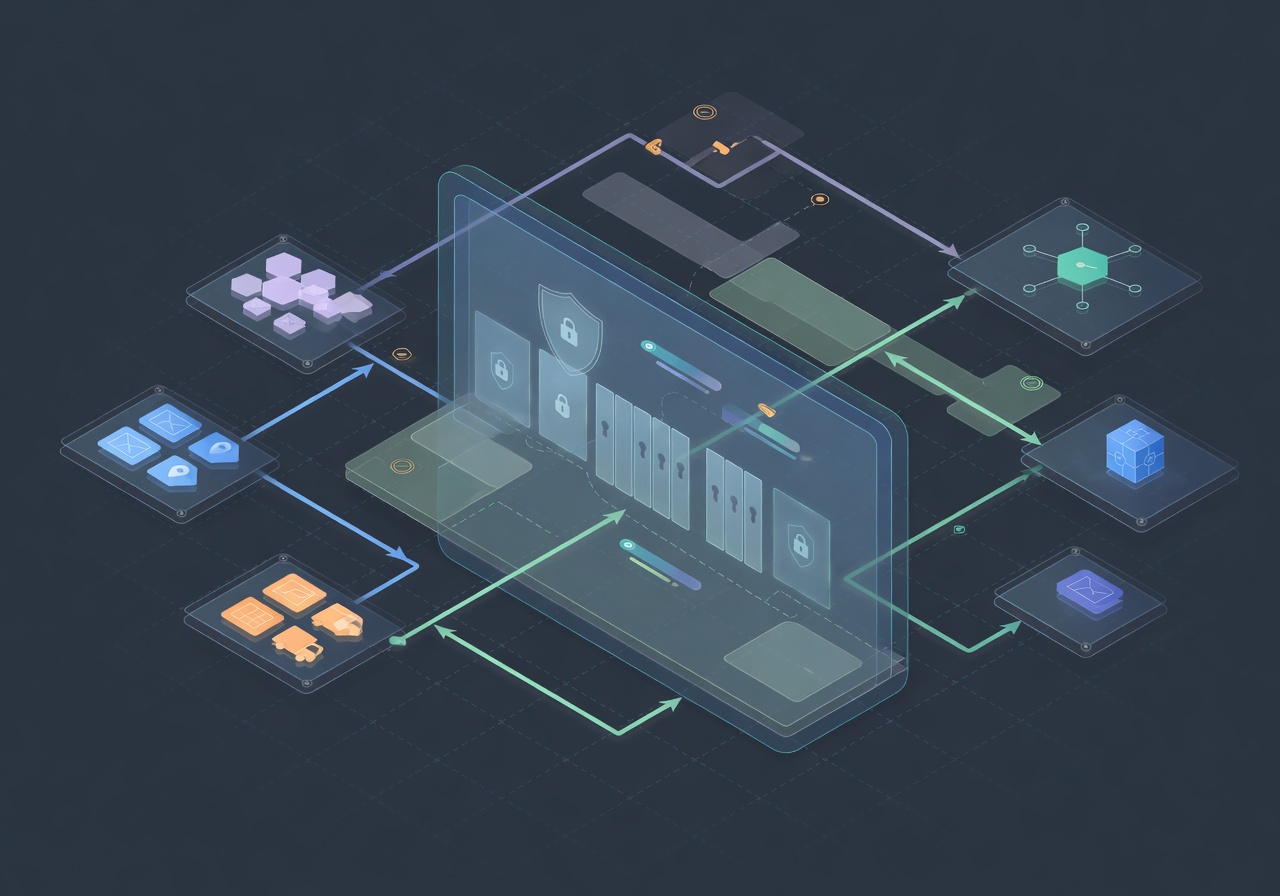
How RouteFreely Routes AI Work
RouteFreely should be understood as operating logic, not just a model selector. A request may move through several decision points before it reaches an AI endpoint.
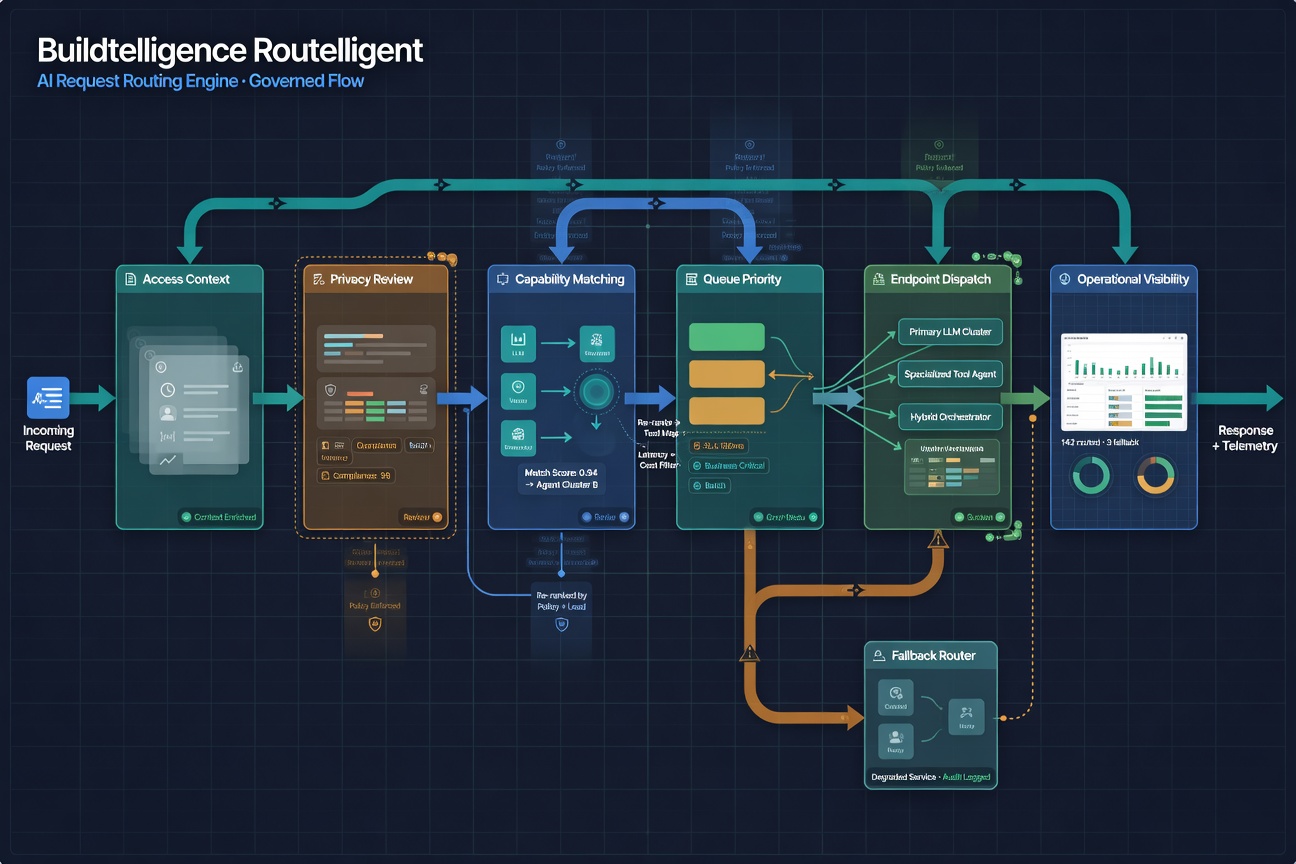
- Request Ingress: The request enters ThinkFreely from a user, assistant, application, workflow, API, or skill surface.
- User and Access Context: The system evaluates who is making the request, what the user is allowed to access, which endpoints are available to that user or group, and what organizational rules apply.
- Policy and Privacy Review: The request is checked against tenant, privacy, sensitivity, and governance rules so routing can respect defined boundaries before dispatch.
- Capability Matching: RouteFreely evaluates what kind of AI capability the request needs and which approved endpoints, models, or skills can support it.
- Queue and Priority Handling: The work can be placed into the appropriate queue or priority path based on urgency, workload pressure, resource availability, cost, or business importance.
- Endpoint Dispatch: The request is sent to the selected model, endpoint, skill, or workflow path.
- Failover and Recovery: If the preferred path is unavailable or unsuitable, RouteFreely can support routing through an approved fallback path according to policy.
- Operational Visibility: Routing behavior can be logged, inspected, and reviewed so operators can understand what happened, where work went, and how the system handled the request.
Enterprise Control Beyond Model Selection
A simple model picker can be useful for experimentation, but it is not enough for enterprise AI implementation.
RouteFreely supports a more governed operating model by connecting routing decisions to organizational control.
- which users or groups can access which endpoints
- which models are approved for which workflows
- which skills are exposed to which applications or departments
- which requests require privacy-aware routing
- which workloads should receive priority
- which endpoints are eligible for failover
- which model paths should be avoided for sensitive work
- which usage patterns need visibility
This lets companies deploy AI in a way that feels simpler to users while giving operators more control beneath the surface.
Model Picker vs. AI Routing Engine
Model Picker
- user decides which model or endpoint to use
- useful mainly for experimentation
- limited policy awareness
- places routing burden on the end user
- weak fit for governed enterprise workflows
RouteFreely AI Routing Engine
- system routes work according to policy, capability, access, and context
- designed for operating-layer control
- supports privacy-aware routing, queueing, and fallback paths
- reduces manual endpoint decisions for users
- stronger fit for enterprise AI implementation

Practical Use Cases for RouteFreely
Department-Specific AI Assistants
Route work to approved assistants, skills, and endpoints based on department access, workflow context, and security group permissions.
Skill-Based AI Workflows
Expose or hide specific skills by user, group, application, or endpoint so work is routed to the right controlled capability.
Private Knowledge Workflows
Route sensitive knowledge work through approved privacy-aware paths before sending requests to a model or retrieval layer.
Queue-Sensitive Workloads
Prioritize urgent or high-value AI work while managing lower-priority requests through defined queues.
Failover for Reliability
Support approved fallback paths when a preferred endpoint is unavailable, overloaded, or unsuitable.
Cost-Aware Routing
Use lower-cost or lower-token paths when appropriate and reserve more capable, context-heavy, or expensive models for work that requires them.
Application Decoupling
Allow applications to stay lighter by routing to skills, endpoints, and model paths through ThinkFreely rather than hardcoding every AI behavior into each application.
Governance-Aware AI Access
Make endpoint availability depend on approved permissions, tenant rules, privacy constraints, and organizational policy.
RouteFreely and DriftHold
RouteFreely and DriftHold solve different parts of the enterprise AI control problem.
RouteFreely decides where AI work should go.
DriftHold helps keep that work aligned with the instructions, policies, skills, and context that matter after the request is assembled and processed.
RouteFreely routes AI work. DriftHold keeps it aligned.
Together, they support the broader purpose of ThinkFreely: giving companies visibility, direction, and control across AI models, queues, privacy boundaries, workflows, and governance.
Why RouteFreely Matters for Mid-Sized Companies
Mid-sized companies may not need bloated enterprise AI infrastructure, but they do need routing control as AI usage spreads across departments, assistants, skills, and sensitive workflows.
RouteFreely gives ThinkFreely a practical routing foundation for companies that are ready to move from scattered AI usage to governed implementation. It supports AI model routing, access control, workload visibility, and approved fallback behavior without forcing each application or department to solve those decisions independently.
For leadership, RouteFreely supports visibility and control. For technical teams, it centralizes routing logic that would otherwise be duplicated across applications. For users, it can simplify the experience by reducing the need to choose between models, endpoints, or skill paths manually.
Business Value of RouteFreely
Simpler User Experience
Users do not need to understand every model, endpoint, queue, or policy path. RouteFreely can help route work through approved pathways behind the scenes.
Better Operational Control
Leadership and operators gain a clearer way to manage where AI work goes, which endpoints are available, and how routing aligns with policy.
Stronger Governance
Routing can reflect user permissions, privacy requirements, tenant policy, workflow rules, and organizational boundaries.
More Reliable AI Workflows
Failover and queue-aware routing can reduce workflow disruption when preferred endpoints are unavailable, overloaded, or unsuitable.
Lower Application Complexity
Applications can rely on ThinkFreely for routing logic instead of hardcoding AI model selection, skill exposure, fallback behavior, and endpoint rules into every surface.
Reduced AI Token Use
RouteFreely can help reduce unnecessary token use by routing requests through more appropriate models, skills, endpoints, and workflow paths instead of defaulting every task to large prompts, broad context, or expensive model routes.
More Scalable AI Adoption
As AI usage grows, RouteFreely gives companies a centralized way to manage routing decisions instead of letting each workflow evolve separately.
Frequently Asked Questions About RouteFreely
What is an AI routing engine?
An AI routing engine determines where AI requests should go based on factors such as capability, access, privacy requirements, endpoint availability, workload priority, policy, and operational health.
What is AI model routing?
AI model routing is the process of sending a request to the model or endpoint best suited for the task. In an enterprise environment, routing may also account for permissions, data sensitivity, token use, cost, latency, workflow requirements, and fallback options.
What is LLM routing?
LLM routing is the process of directing a request to the appropriate large language model or endpoint based on the task, token use, cost, latency, privacy requirements, availability, or workflow rules.
Is RouteFreely just a model picker?
No. A model picker asks users to choose. RouteFreely supports operating-layer routing based on permissions, capability, privacy rules, queues, endpoint health, failover paths, and workflow context.
How does privacy-aware AI routing work?
Privacy-aware AI routing applies privacy, tenant, sensitivity, or policy rules before a request is dispatched. The goal is to reduce uncontrolled data exposure and make AI routing consistent with organizational boundaries.
What is AI failover?
AI failover is the use of approved fallback paths when a preferred model, endpoint, or route is unavailable or unsuitable. Approved fallback paths can help reduce workflow interruption.
How can AI routing reduce token use?
AI routing can support more token-efficient patterns by sending work to the right model, endpoint, skill, or context path for the task. Instead of sending every request through the largest model or broadest prompt, RouteFreely can help reserve stronger models and heavier context for the work that actually needs them.
How does RouteFreely relate to DriftHold?
RouteFreely routes AI work to the appropriate model, endpoint, queue, skill, or path. DriftHold helps keep that work aligned with the instructions, policies, skills, and context that matter.
Where does RouteFreely fit inside ThinkFreely?
RouteFreely is the routing, ingress, queueing, privacy-aware dispatch, and failover subsystem inside ThinkFreely, the AI Operating Layer Buildtelligence implements.
Route AI Work More Efficiently Across Models, Skills, and Policy Paths
AI implementation becomes harder to manage when every application, team, user, and workflow makes its own routing decisions.
RouteFreely gives ThinkFreely a controlled routing engine for enterprise AI. It helps direct AI work across models, endpoints, queues, privacy boundaries, skills, cost-efficient paths, and fallback options so companies can scale AI adoption with more visibility, direction, and control.
RouteFreely routes AI work. DriftHold keeps it aligned.