
AI Consulting
AI Consulting for Strategy, Planning, Expansion, and Repair
AI consulting should help companies make better decisions about where AI belongs, what should happen next, and how to improve what is already in motion. Buildtelligence provides AI consulting services for mid-sized companies that need practical guidance across any stage of AI adoption. Strategic advice before investment, implementation planning, expansion of early usage, or help repairing scattered or underperforming efforts.
Which consulting decision point fits my situation? What deliverables come out of AI consulting?
The Problem With Generic AI Advice
Many companies are surrounded by AI advice. Vendors are promoting platforms. Employees are testing tools. Industry content is full of predictions. Leadership teams are hearing that AI will change everything, but that does not automatically explain what should change inside their business.
A company does not need AI guidance in the abstract. It needs guidance that accounts for its workflows, people, systems, customer expectations, data sensitivity, risk tolerance, budget, and operational capacity. Advice that sounds impressive but ignores those realities can create more confusion than clarity.
Buildtelligence approaches AI consulting as a practical decision-making function. We help companies understand what AI can do, what it should do, what it should not do yet, and what conditions need to exist before adoption expands.
AI Consulting for Every Stage of Adoption
Buildtelligence supports companies across four common decision points. The right engagement depends on where you are now.
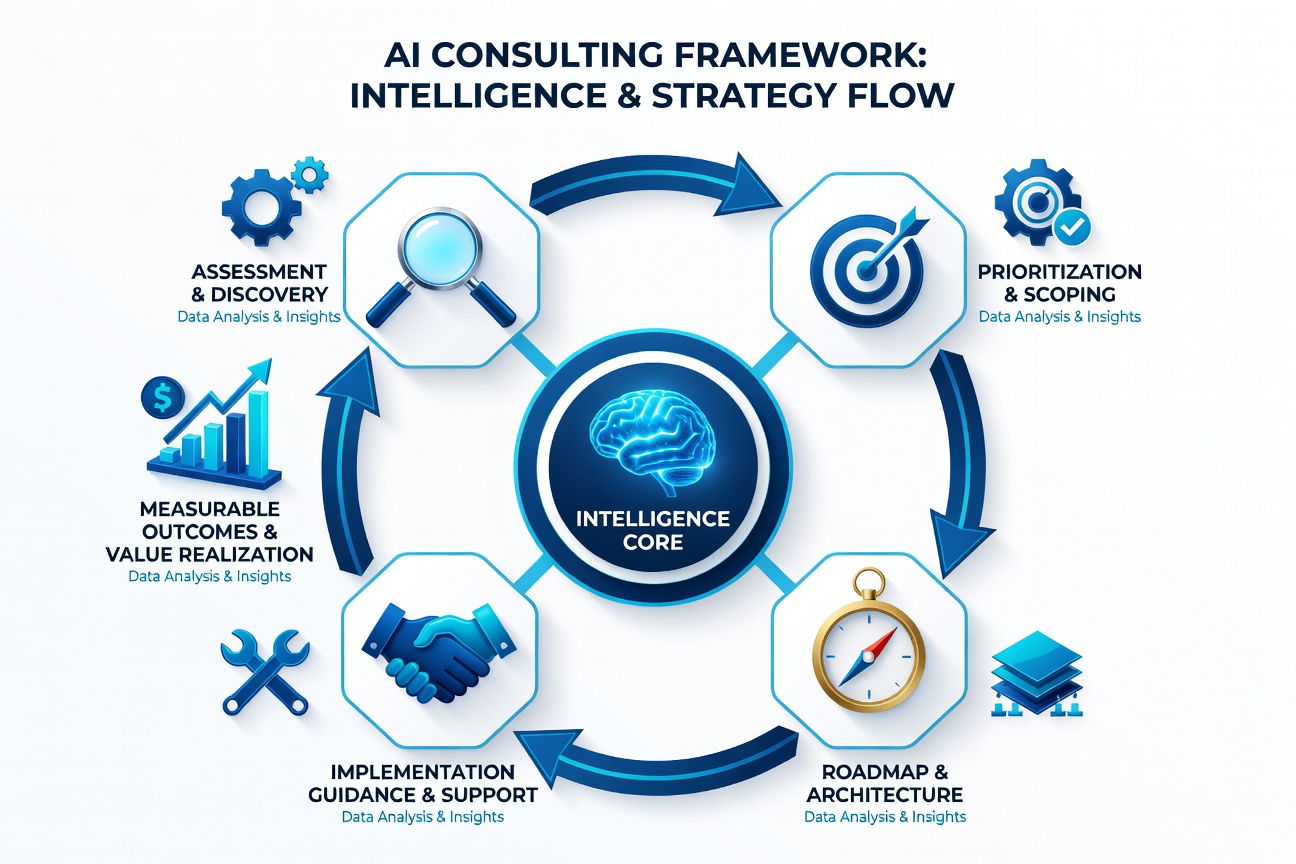
01 Strategy
Strategic Advice
For leadership teams who need clarity before investing. Define what AI realistically means for the business.
02 Planning
Implementation Planning
For companies ready to move forward who need a usable roadmap, sequencing, and a defensible first project.
03 Expansion
Expansion of Existing Usage
For companies with informal AI activity that needs to scale into repeatable, governed team systems.
04 Repair
Improvement & Repair
For struggling AI initiatives where adoption is weak, outputs are inconsistent, or business value is unclear.
01. Strategic Advice
When You Need Strategic AI Advice
Some companies are not ready to implement yet. They need to understand the landscape, define what AI means for their business, and make better strategic decisions before committing resources.
- What should we realistically expect from AI?
- Which parts of our business are most likely to benefit?
- What risks should we understand before moving forward?
- What are competitors likely to do?
- Which tools or categories are worth evaluating?
- How should we think about governance before employees move faster than policy?
What Strategic Advice Should Produce
Good strategic advice should help leadership separate opportunity from noise. Buildtelligence helps identify where AI could matter based on actual business functions, not generic trends.
What Strategic Advice Should Avoid
Strategic advice should not create false urgency. The value of consulting at this stage is disciplined judgment. Sometimes the right recommendation is to move forward. Sometimes it is to narrow the scope. Sometimes it is to solve governance or data readiness issues before investing in tools.


02. Implementation Planning
When You Need Implementation Planning
Some companies already know they want to move forward but do not know how to sequence the work. They have leadership support, budget interest, and a general sense of opportunity, but lack a usable roadmap.
Implementation planning is useful when the questions shift from “Should we use AI?” to “How do we do this correctly?”. Which workflows come first, who needs to be involved, what systems and policies are required, what training is needed, what should be measured.
Building the Roadmap
Buildtelligence helps companies prioritize based on value, feasibility, governance needs, workflow fit, and implementation difficulty. The roadmap may point toward AI workflow implementation, private knowledge assistants, governance and training, architecture review, or ThinkFreely.
Avoiding the Wrong First Project
One of the most common AI mistakes is choosing the wrong first project. A better first project is often narrower, easier to govern, connected to a real workflow, and useful enough to build trust.
03. Expansion
When You Need to Expand Existing AI Usage
Many companies are already using AI before they have a formal strategy. Employees are testing tools, managers are building prompts, departments are experimenting with assistants, and early wins are happening in pockets.
Turning Experiments Into Repeatable Systems
Individual AI usage often depends on personal habits. If those practices are not documented, trained, governed, and improved, the organization does not really own them. Buildtelligence helps convert useful experiments into repeatable AI skills, workflow instructions, team guidance, governance rules, and implementation patterns.
Expanding Without Losing Control
Expansion increases risk if the operating structure does not mature with usage. Expansion should make AI more useful, not harder to manage.

04. Repair
When You Need to Improve or Repair an AI Initiative
Not every AI effort works well the first time. Some companies buy tools that employees do not adopt. Some roll out policies that are ignored. That does not mean the company should abandon AI. It may mean the initiative needs repair.
Diagnosing What Is Actually Broken
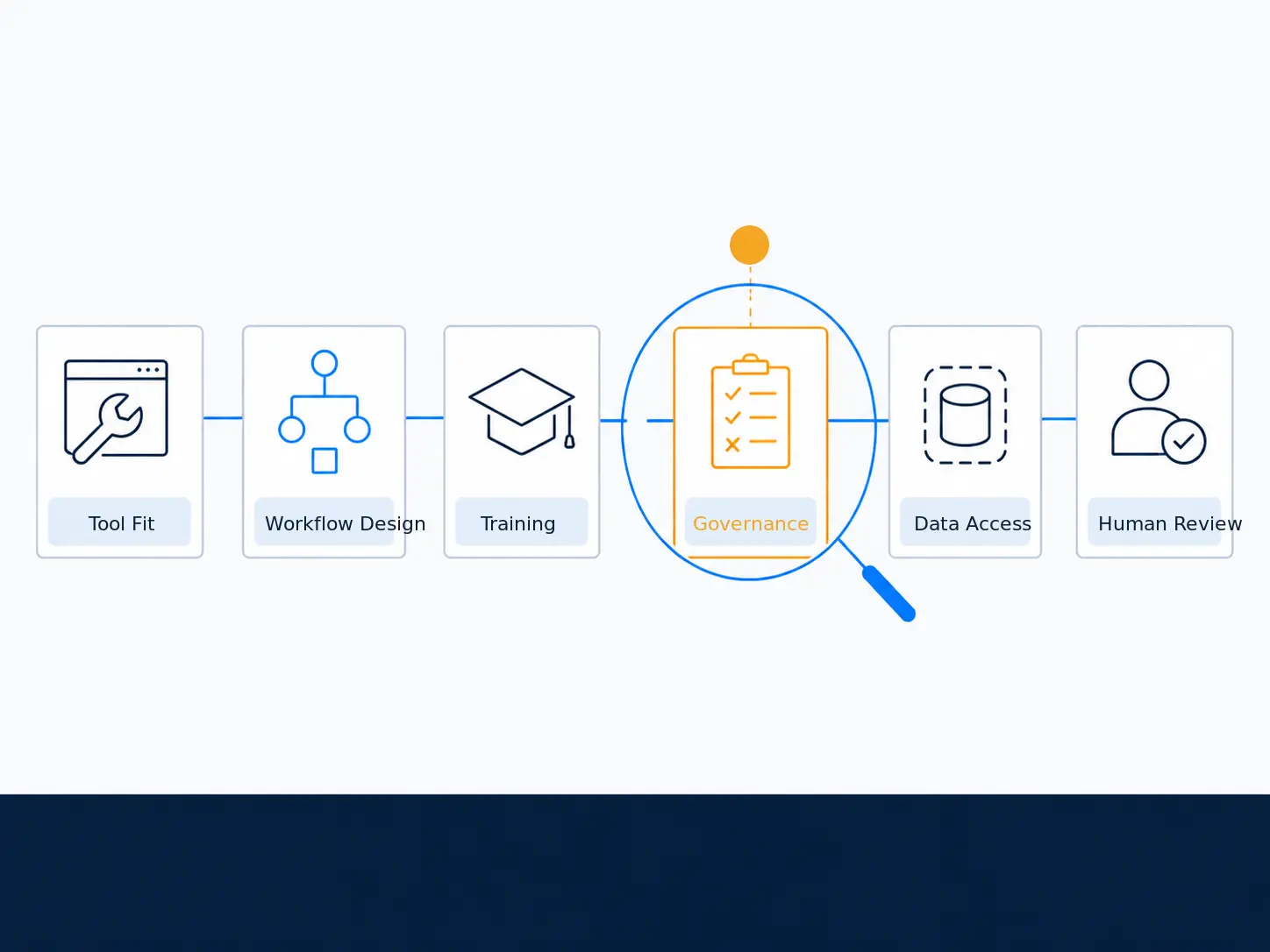
A struggling AI initiative can fail for many reasons: tool fit, workflow design, training, governance, data access, leadership alignment, or unrealistic expectations. Fixing the wrong problem wastes time. Buildtelligence helps review the initiative from an operating perspective and creates a clearer view of whether it should be repaired, narrowed, rebuilt, paused, or replaced.
Repairing the Operating Structure
Repair often means rebuilding the structure around the tool or workflow. Clarifying ownership, rewriting usage rules, simplifying the use case, creating training materials, improving human review, or redefining success metrics. Sometimes repair also means reducing complexity.
How the Consulting Process Works
A four-step engagement designed to clarify the decision the company actually needs to make.
01
Establish Current State
Identify what is already happening. Approved tools, informal usage, existing policies, stakeholder expectations, and prior AI projects. Prevent assumption-driven engagements.
02
Clarify Decision Point
Different companies need different decisions. Anchor the engagement to the decision the company actually needs to make next.
03
Evaluate Opportunity & Risk
Evaluate opportunity and risk together so recommendations are clear and usable. Architecture review may be needed.
04
Define Recommended Path
Clarify what should happen next. And what should not happen yet. Avoiding the wrong next step is often as valuable as choosing the right one.
What You Get
A Buildtelligence consulting engagement is designed to produce structured clarity. Deliverables depend on stage and need.
- A current-state assessment of AI usage and readiness
- A prioritized list of AI opportunities
- A recommended adoption roadmap
- Governance and policy recommendations
- Workflow-level recommendations
- Tool, architecture, or vendor observations
- Training and enablement recommendations
- A repair plan for struggling initiatives
- Recommendations for future implementation support
Practical Scenarios
How AI consulting engagements look in real organizations.
Scenario A
Leadership needs strategic advice
A leadership team knows AI is important but does not know what it means for their company. Buildtelligence clarifies where AI is likely to create value, what risks should be understood first, and what level of investment is appropriate.
Outcome: A clearer decision framework, not a generic AI opinion.
Scenario B
Implementation plan needed
A company has decided to move forward but does not know which workflow should come first. Buildtelligence evaluates use cases, defines the first phase, identifies stakeholders, and creates a decision-ready roadmap.
Outcome: A more realistic implementation path that reduces false starts.
Scenario C
Early AI usage needs to expand
A few employees have found useful ways to use AI, but practices are informal. Buildtelligence documents what is working, converts individual practices into repeatable AI skills, and creates governance standards.
Outcome: Broader adoption without losing visibility or control.
Scenario D
An AI initiative needs repair
A company rolled out an AI tool, but adoption is weak, outputs are inconsistent, or the business value is unclear. Buildtelligence reviews what happened, identifies root issues, and recommends whether to repair, simplify, rebuild, pause, or replace.
Outcome: A practical recovery path instead of unfocused experimentation.
Frequently Asked Questions
What does an AI consulting company do?
An AI consulting company helps organizations understand AI opportunities, evaluate risks, define strategy, plan implementation, improve existing usage, and make better technology decisions. Buildtelligence focuses on practical guidance that connects advice to real operating conditions.
Do we need AI consulting if we are not ready to implement yet?
Yes. AI consulting can be valuable before implementation because it helps leadership understand what is practical, what should be avoided, what risks matter, and what kind of adoption path makes sense.
Can AI consulting help if we already use AI?
Yes. Many companies need consulting after early adoption begins. Buildtelligence can help organize existing usage, expand what is working, improve governance, reduce tool sprawl, or repair initiatives that are not performing as expected.
Can you help if our AI initiative is not working?
Yes. Buildtelligence can review adoption, workflow design, tool fit, governance, training, data access, ownership, and expectations. From there, we can recommend whether the initiative should be repaired, simplified, rebuilt, paused, or replaced.
How is AI consulting different from AI enablement?
AI consulting helps the company make better decisions about strategy, planning, expansion, or repair. AI enablement focuses on building the readiness, training, governance, workflow structure, and adoption systems needed to use AI consistently.
How is AI consulting different from AI implementation?
AI consulting helps define what should happen and why. AI implementation turns approved priorities into working workflows, systems, skills, governance practices, or operating-layer support.
What types of companies are a good fit for Buildtelligence?
Buildtelligence is built for mid-sized companies that need practical AI guidance without unnecessary enterprise bloat. These companies often have meaningful workflows, data concerns, leadership pressure, and a need for structured decision-making.
Can Buildtelligence help us evaluate AI tools or vendors?
Yes. Tool and vendor review can be part of the consulting process. The goal is to evaluate tools based on business fit, workflow requirements, privacy considerations, governance needs, cost, and implementation practicality.
What is the best first step?
For many companies, the best first step is an AI readiness assessment. That provides a clearer view of current usage, opportunities, risks, governance gaps, and practical next steps.

Get AI Consulting That Clarifies the Next Step
Whether your company needs strategic advice, an implementation plan, expansion guidance, or help repairing an imperfect rollout, Buildtelligence helps turn AI uncertainty into a practical path forward.