
AI Enablement
AI Enablement That Turns Interest Into Traction
AI enablement is the structured process of helping a company turn AI interest into practical business traction. Many organizations already have access to AI tools, but they still struggle to decide where AI belongs, what should be governed, which workflows should come first, and how to turn experimentation into measurable progress. Buildtelligence helps mid-sized companies create the strategy, structure, and implementation path needed to use AI without losing visibility, direction, or control.
What does AI enablement include? How is enablement different from consulting?
What Is AI Enablement?
AI enablement is not the same thing as buying AI software. It is not a training session by itself. It is not a list of prompts. It is the operating structure that helps an organization adopt AI in a way that is practical, governed, and connected to real work.
At its simplest, AI enablement answers several important questions:
- Where can AI create useful business value?
- Which use cases should be prioritized first?
- What data, systems, and workflows are involved?
- What rules should govern employee usage?
- What training does the team need?
- What should be automated, assisted, reviewed, or avoided?
- How will leadership know whether AI adoption is working?
Without those answers, AI remains scattered. With those answers, AI can begin to move from individual experimentation into organizational capability.
Buildtelligence helps companies create that path. We focus on the practical layer between AI awareness and implementation, where ideas become priorities, priorities become workflows, and workflows become repeatable systems. AI consulting may help define recommendations; AI enablement focuses on building the internal readiness, structure, and adoption path needed to act on them.

Why Tools Alone Fail
AI tools are powerful, but tools do not automatically create adoption. A company can give employees access to models, assistants, copilots, automation platforms, and knowledge tools and still see little operational change.
The problem is that tools require context. They need defined use cases, approved data sources, workflow rules, quality expectations, access controls, and a clear understanding of what human review still needs to handle.
When tools arrive without structure:
- Employees use different platforms without shared standards.
- Sensitive information may be entered into systems without clear rules.
- Prompts and workflows are created individually but not reused across teams.
- Leadership cannot see what is being used or whether value is being created.
- Teams struggle to move from interesting experiments to durable process change.
Symptoms of an AI Enablement Gap
No clarity on approved tools
Employees are using AI, but no one can clearly say which tools are approved, which policies apply, or where sensitive information is being protected.
Ideas, no prioritization
Departments have promising AI ideas, but no consistent process for evaluating value, feasibility, or risk.
Knowledge stays with one person
A team builds a useful prompt, but the knowledge stays with one person instead of becoming a repeatable skill.
Discussion without movement
AI keeps coming up in meetings, but implementation does not move forward.
Misalignment across teams
IT, operations, leadership, and department heads are not aligned on what AI should do or who owns it.
Governance hesitation
Governance concerns slow progress because policies are unclear.
Usage outpaces training
AI usage is growing faster than training. Employees are figuring it out individually.
Tool sprawl
Multiple tools are being tested without a shared evaluation framework.
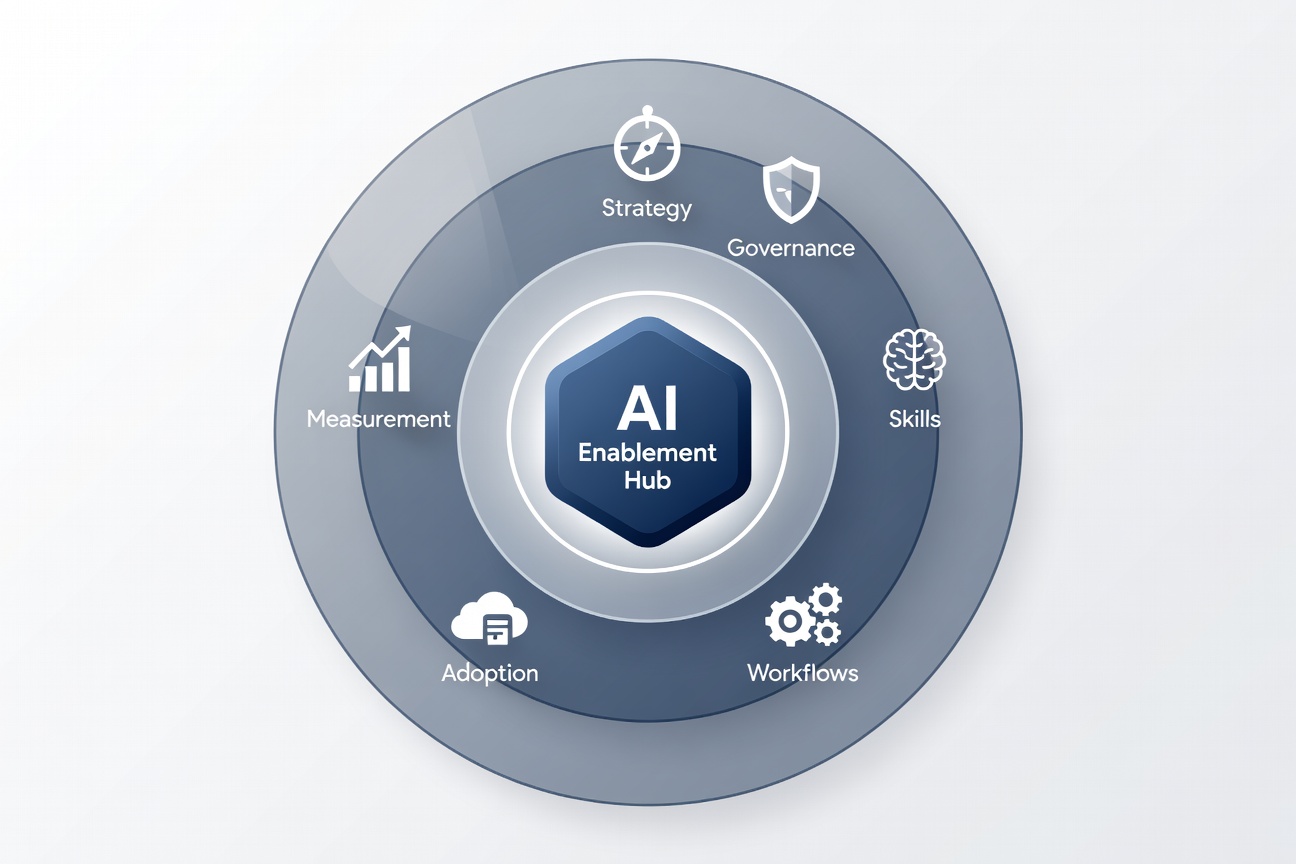
The Buildtelligence AI Enablement Framework
Buildtelligence organizes AI enablement around three layers of structure.
Visibility
Visibility means leadership can understand what AI activity is happening, where it is happening, and what it touches. That includes tools, data, workflows, departments, user behavior, training needs, and risks.
Without visibility, AI adoption becomes difficult to manage. Visibility helps identify the current state before the company chooses the next step.
Direction
Direction means the organization has a practical way to decide what AI should do first. Not every idea is ready for implementation. Some use cases are valuable but complex. Some create unnecessary risk.
Buildtelligence helps companies evaluate use cases based on business value, feasibility, workflow fit, privacy considerations, adoption difficulty, and operational readiness.
Control
Control means the company can govern AI usage as adoption grows. That includes policies, access rules, privacy boundaries, training, workflow standards, model usage decisions, quality review, and escalation paths.
Control does not mean slowing AI down. It means creating the structure needed to let teams use AI safely and consistently.
What AI Enablement Helps You Achieve
enablement helps companies move from broad interest to practical traction. The outcome is not simply more AI activity. The outcome is better AI activity.
- Identify high-value AI opportunities
- Reduce scattered tool usage
- Create clearer governance around employee use
- Protect sensitive information more consistently
- Prioritize workflows with real business impact
- Build repeatable AI skills instead of one-off prompts
- Train teams around approved use cases and expectations
- Measure adoption and refine implementation over time

What You Get
- AI readiness assessment
- Current-state AI usage review
- Use case discovery and prioritization
- Workflow opportunity mapping
- Governance and policy recommendations
- Team training and adoption planning
- AI skills development
- Private knowledge assistant planning
- Architecture and tool review
- ThinkFreely planning where an AI Operating Layer is appropriate
Frequently Asked Questions
What is enablement?
enablement is the structured process of helping an organization use AI in a practical, governed, and workflow-connected way. It includes strategy, use case prioritization, training, governance, workflow design, and implementation planning.
How is enablement different from AI implementation?
enablement creates the structure required for adoption. AI implementation turns that structure into working workflows, systems, and operating processes. Enablement often comes first.
Do we need enablement if our team is already using AI?
Yes, in many cases. Existing usage can be a good sign, but it can also create risk if there are no shared standards, policies, training, or visibility. enablement helps organize that activity.
Is enablement only for technical teams?
No. enablement involves leadership, operations, department heads, technical stakeholders, and the employees who will use AI in their work. It is both a business and technology process.
What does Buildtelligence deliver during enablement?
Deliverables may include readiness assessment, use case prioritization, workflow maps, governance recommendations, training plans, AI skills, implementation roadmaps, and recommendations for tools or operating-layer support.
Where should we start?
Most companies should start with an AI readiness assessment. That helps clarify current usage, opportunities, risks, governance gaps, and the most practical next step.

Move From Interest to Practical AI Traction
enablement gives your company the structure needed to move forward with clarity. Buildtelligence helps you identify what matters, govern what needs control, and turn AI interest into implementation.