
Private Knowledge Assistants
Make Your Internal Knowledge Usable With AI
A private knowledge assistant helps companies make internal knowledge easier to access, use, and apply without turning sensitive information into unmanaged AI activity. Many organizations have valuable knowledge spread across documents, systems, teams, and long-tenured employees, but that knowledge is often difficult to find when people need it. Buildtelligence helps mid-sized companies design private knowledge assistants that make approved information and captured expertise more accessible while supporting governance, permissions, workflow fit, and practical AI adoption.
What is a private knowledge assistant? How is sensitive information protected?
The Knowledge Problem
Most companies already have the information their teams need. The problem is that the information is scattered. It may live in policy documents, training materials, proposals, SOPs, tickets, meeting notes, emails, project systems, shared drives, CRMs, PDFs, spreadsheets, wikis, or the memory of experienced employees.
That creates operational friction. People ask the same questions repeatedly. Managers become bottlenecks. New employees take longer to ramp up. Teams make inconsistent decisions because they rely on different sources. Valuable institutional knowledge remains trapped in documents or people instead of becoming usable across the organization.
A private knowledge assistant can help solve that problem by making approved knowledge easier to retrieve and apply in a controlled way.
What a Private Knowledge Assistant Does
A private knowledge assistant is an AI-supported system designed to help users access and apply internal knowledge. It can answer questions, summarize approved materials, surface relevant policies, help interpret documentation, and support repeatable knowledge-based tasks.
The key word is private. Private means the assistant should be scoped to approved knowledge sources, access permissions, privacy expectations, and company-controlled use cases. It should not be an unmanaged chatbot pointed at sensitive company data without structure.
- Find relevant internal information faster
- Understand policy or process details
- Summarize long documents
- Compare related materials
- Prepare internal briefings
- Support training and onboarding
- Apply approved knowledge to recurring tasks
- Reduce repeated questions to managers or experts
- Preserve institutional knowledge
- Improve consistency across teams

Human Expertise as a Knowledge Source
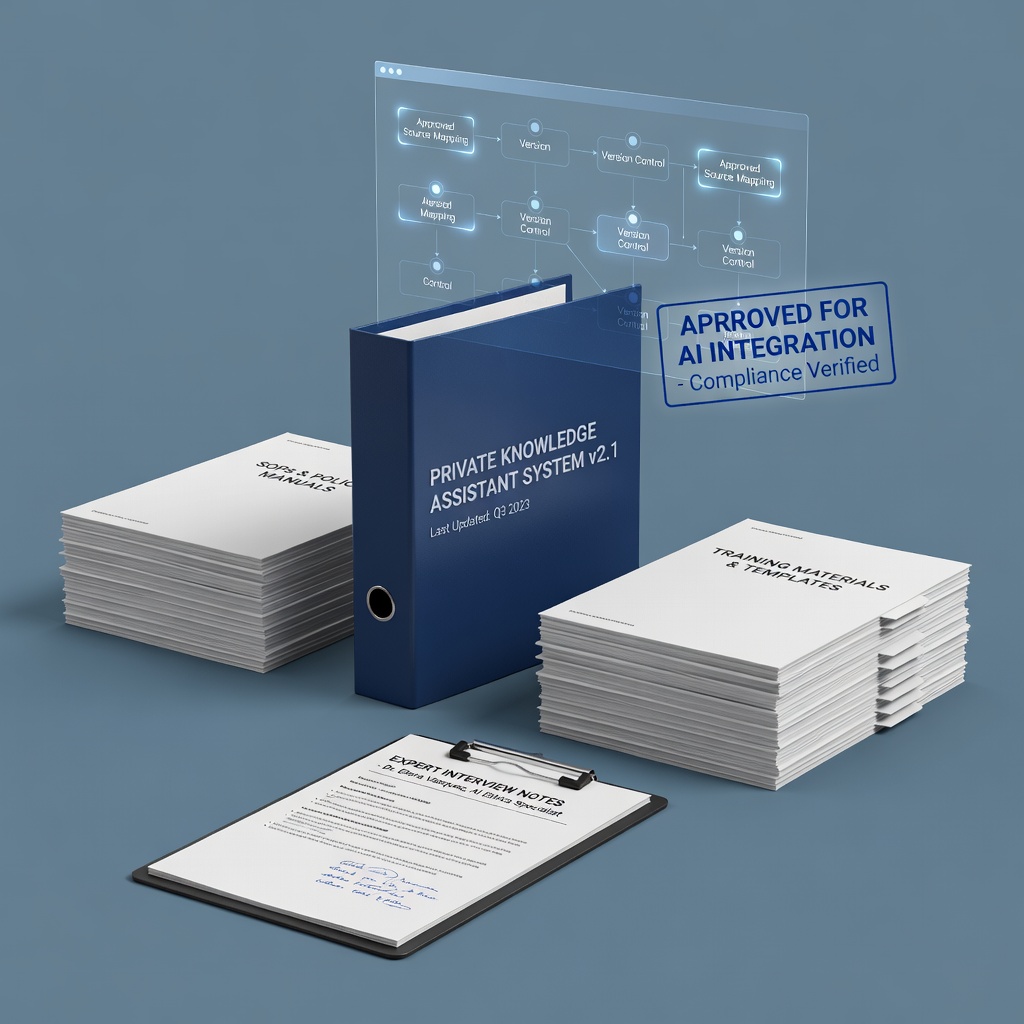
Not all valuable company knowledge lives in files. Some of it lives in executives, managers, subject-matter experts, senior operators, and key employees who understand how the business actually works. That knowledge may include management decision rules, executive judgment, client handling standards, sales qualification logic, escalation patterns, risk recognition, review habits, internal exceptions, department-specific terminology, historical context, and “how we do this here” knowledge.
Buildtelligence can help extract this critical human knowledge and structure it so it can support private knowledge assistants, AI skills, and workflow implementation. For a private knowledge assistant, the goal is to make captured expertise easier to access. For example, an employee asking how the company typically handles a certain escalation, where to find the approved process, or what factors a manager normally considers before a decision moves forward.
Private knowledge assistants help people access information. AI skills help people repeat a task using that information. In many implementations, captured human expertise can support both.
Knowledge Sources
A private knowledge assistant is only as useful as the knowledge it can access and the rules that govern how that knowledge is used.
- Standard operating procedures
- Internal policies
- Training materials
- Brand and voice guides
- Product or service documentation
- Sales enablement materials
- Client service standards
- Support documentation
- Historical decisions
- Meeting notes and summaries
- Knowledge base articles
- Project documentation
- HR or administrative guidance
- Compliance or review checklists
- Approved examples and templates
- Executive, management, and SME knowledge captured through interviews
Poor source quality produces poor assistant quality. Sources may need cleanup, consolidation, version control, or approval review before implementation.
Governance, Permissions, and Role-Based Access
A private knowledge assistant needs governance from the beginning. The organization should define what information the assistant can access, who can use it, what outputs require review, what should remain restricted, and when the assistant should decline or escalate instead of answering.
- Source approval rules
- User access permissions
- Department or role-based access
- Privacy boundaries and sensitive data restrictions
- Retrieval limitations
- Escalation requirements
- Response quality standards
- Update and maintenance processes
- Human review rules
- Expert validation for captured human knowledge
Not every user should be able to access every knowledge source. HR materials, finance documents, legal guidance, client records, executive context, and sensitive operational information may all require different access rules. Role-based access planning helps define who can use the assistant, which sources they can access, what answers they can receive, and when a request should be restricted or escalated.
ThinkFreely is not required for every private knowledge assistant, but it may be recommended when the assistant needs stronger privacy-aware handling, routing, usage visibility, instruction stability, or governance control.
Practical Scenarios

Scenario 1
Employees Cannot Find the Right Information
Map approved knowledge sources and design a private knowledge assistant that makes information easier to access. Faster retrieval, fewer repeated internal questions.
Scenario 2
Managers Are Becoming Knowledge Bottlenecks
Identify which knowledge should be captured, what needs human review, and how a private knowledge assistant can support employees without removing management oversight.
Scenario 3
Executive Judgment Needs to Be Easier to Reference
Extract leadership guidance through interviews, examples, and workflow review, then structure it so a private knowledge assistant can surface approved guidance when employees need it.
Scenario 4
Onboarding Requires Too Much Manual Support
Design a knowledge assistant that supports onboarding by answering common questions, pointing to approved sources, and helping new employees understand internal processes. Faster ramp-up and more consistent training support.
Scenario 5
Knowledge Needs to Support a Workflow
Connect a knowledge assistant to workflow design, and where appropriate, pair it with AI skills that define how the knowledge should be used. Better knowledge application, not just better knowledge search.
When You Need This
- Employees spend too much time searching for internal information
- Knowledge is scattered across systems
- Employees are unsure which source is current
- Managers answer the same questions repeatedly
- Onboarding takes too long
- Internal policies are hard to find
- Teams apply knowledge inconsistently
- Institutional knowledge is concentrated in key employees
- Sensitive information needs controlled access
- Expert judgment needs to be captured before it becomes a bottleneck
When This Is Not the Right Fit
Not the right fit if the company has not identified useful knowledge sources or meaningful use cases, or if available information is outdated, inaccurate, contradictory, or not approved for use. In that case, knowledge cleanup, source review, or AI readiness work may need to come first.
It may also not be appropriate if the organization expects AI to answer sensitive questions without governance, permissions, source controls, or human review. Review AI governance and training.
Frequently Asked Questions
What is a knowledge assistant?
A knowledge assistant is an AI-supported system that helps employees access and apply approved internal information. It can answer questions, summarize documents, surface relevant sources, and support knowledge-based workflows.
How is a knowledge assistant different from a chatbot?
A chatbot is usually a conversational interface. A knowledge assistant is designed around approved knowledge sources, access rules, governance, privacy boundaries, and business workflows.
What information can a knowledge assistant use?
It can use approved internal sources such as policies, SOPs, training materials, documentation, templates, support materials, brand guides, knowledge base articles, and captured expert guidance. The specific sources should be reviewed and approved before use.
Do we need to clean up our documents first?
Sometimes. If sources are outdated, contradictory, duplicated, or unapproved, knowledge cleanup should happen before or during implementation. Better source quality leads to better assistant quality.
Can different employees see different information?
Yes. A knowledge assistant should be designed around access rules, role-based permissions, source restrictions, and privacy requirements.
Can a knowledge assistant use employee expertise?
Yes. Buildtelligence can help extract knowledge from executives, managers, subject-matter experts, and key employees, then structure that knowledge so it can support the assistant, related AI skills, or workflow implementation.
How is this different from AI skills?
Knowledge assistants help users access information. AI skills define how information should be used in a repeatable task or workflow. A knowledge assistant may answer a question; an AI skill may use the answer inside a structured process.
Does a knowledge assistant require ThinkFreely?
Not always. Some knowledge assistants can operate inside existing tools. ThinkFreely may be recommended when the assistant needs stronger privacy-aware handling, routing, usage visibility, instruction stability, or governance support.
How do knowledge assistants connect to AI workflow implementation?
Knowledge assistants can support workflows by making approved information available at the point of work. In many cases, they are paired with AI workflow implementation so knowledge access becomes part of a repeatable process.
How do we prevent incorrect or outdated answers?
The quality of a knowledge assistant depends on source quality, governance, update processes, response expectations, and human review. Buildtelligence helps companies define approved sources, review requirements, maintenance practices, and expert validation where captured human knowledge is involved.
Do knowledge assistants replace managers or subject-matter experts?
No. They are designed to make approved knowledge and captured expertise easier to access. Managers and subject-matter experts remain important for validation, oversight, exceptions, and refinement.
Make Internal Knowledge Easier to Use
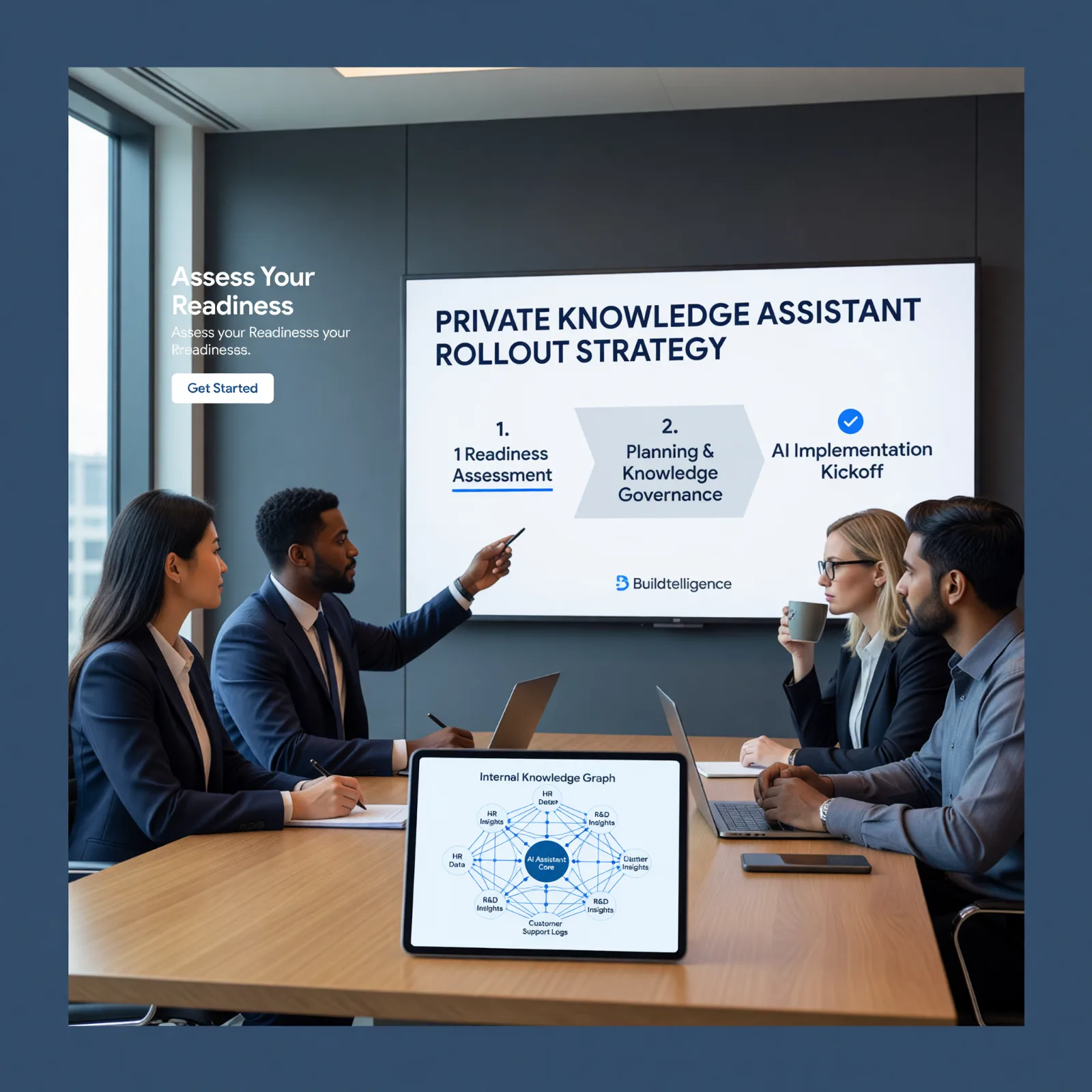
Knowledge assistants help companies make approved internal information and captured human expertise more accessible without turning knowledge access into unmanaged AI activity. Buildtelligence helps identify the right knowledge sources, extract critical expertise, define governance, design the assistant, and connect it to real workflows.