
AI Governance & Training
Give Your Team AI Access Without Losing Control
AI governance helps companies give teams access to AI without losing control over sensitive information, quality standards, workflow consistency, or business risk. Many organizations already have employees using AI, but few have clear rules for what can be used, what should be avoided, what needs review, and how teams should apply AI safely inside real work. Buildtelligence helps mid-sized companies create AI governance and training programs that make adoption more practical, consistent, and controlled.
What does AI governance work include? How does training fit into adoption?
Why AI Governance Matters
AI adoption often starts before a company has a governance structure in place. Employees discover tools, teams begin experimenting, vendors add AI features, and leadership encourages exploration. That early activity can be useful, but it can also create risk if no one has defined the boundaries.
Governance is what turns informal AI usage into a more controlled business capability. It helps answer practical questions: Which AI tools are approved? What information can employees use with AI? Which outputs require human review? Who owns AI-related decisions? How should employees be trained?
Good governance does not stop AI adoption. It makes adoption safer, more consistent, and easier to scale.
Risks Without Governance
Without governance, AI usage can spread faster than leadership can understand or manage.

- Sensitive information being entered into unapproved tools
- Employees relying on inaccurate or unsupported outputs
- Inconsistent client or customer communication
- Hidden tool usage across departments
- Duplicated subscriptions and tool sprawl
- No clear review expectations
- AI-generated work used without accountability
- Employees misunderstanding what AI can and cannot do
- Policies existing in theory but not being trained or followed
- Teams creating their own rules without leadership alignment
Why Policy Alone Is Not Enough
A policy document can define expectations, but it does not automatically change behavior. Employees still need to understand what the policy means, how it applies to their work, which tools are approved, what information is sensitive, and when human review is required.
Policy becomes useful when it is connected to training, workflows, review expectations, tool access, examples, and practical reinforcement. Buildtelligence helps companies turn policy into practical operating guidance.
What We Build
- AI usage policies
- Approved and prohibited use guidelines
- Sensitive data handling rules
- Role-based access guidance
- AI review and approval standards
- Escalation rules
- Department-specific usage expectations
- Training materials for employees and managers
- Workflow-specific AI guidance
- Governance for AI skills and private knowledge assistants
- Governance for captured executive and SME knowledge
- ThinkFreely requirements where stronger control is needed

Role-Based Governance and Training
AI governance should account for different roles. Executives may need visibility into risk, adoption, and operating controls. Managers may need guidance for reviewing AI-supported work and coaching their teams. Employees need clear rules for approved use, sensitive data, source verification, and escalation. Technical or administrative users may need stricter permissions.
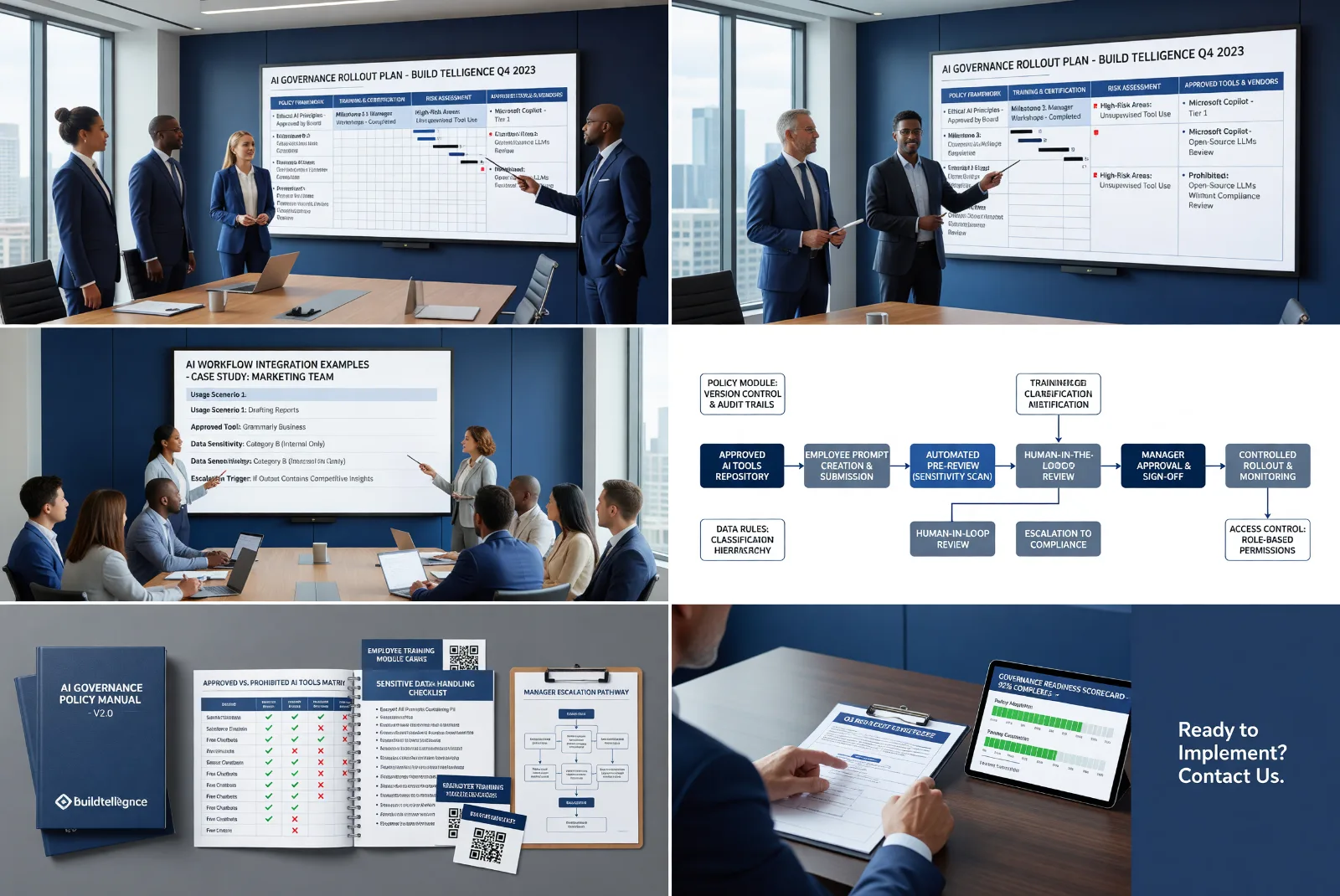
Training framework includes employee training (approved/restricted uses, sensitive data, output review, escalation), manager training (review standards, escalation paths, team coaching), workflow-specific training (different guidance for sales, finance, customer service, operations), and skills/knowledge training (how AI skills and private knowledge assistants work, what sources they rely on, what outputs require review).
Frequently Asked Questions
What is AI governance?
AI governance is the structure a company uses to manage AI access, usage, data handling, review requirements, accountability, and risk. It helps teams use AI productively without creating unmanaged exposure.
Why does governance matter?
Employees may use AI with sensitive information, make decisions from unreliable outputs, or create inconsistent work without clear rules. Governance gives the organization a safer way to adopt AI.
Is governance just a policy document?
No. A policy may be part of governance, but governance also includes training, workflows, review rules, access expectations, escalation paths, and operating controls.
What AI data should employees avoid using?
Sensitive customer, employee, financial, legal, confidential, regulated, proprietary, or client-specific information usually needs explicit rules before AI use.
What does AI training for teams include?
Approved use cases, restricted uses, sensitive data handling, prompt and output review, source verification, escalation requirements, and workflow-specific guidance.
Is AI training a one-time event?
No. AI training should be updated as tools, workflows, policies, risks, and approved use cases change.
Can governance support AI adoption instead of slowing it down?
Yes. When people know what is allowed, what requires review, and what should be avoided, they can use AI with more confidence.
How does ThinkFreely support governance?
ThinkFreely may support governance by helping manage routing, privacy-aware handling, usage visibility, workflow control, priority handling, and instruction stability where the existing environment does not provide enough control.
Do we need governance before launching AI skills or knowledge assistants?
Usually, yes. AI skills and private knowledge assistants need rules around access, sources, review, privacy, and maintenance before they become part of real business work.
Can Buildtelligence train managers separately from employees?
Yes. Managers often need different training because they are responsible for review, escalation, team guidance, and operational oversight.
Give Teams AI Access With Practical Control
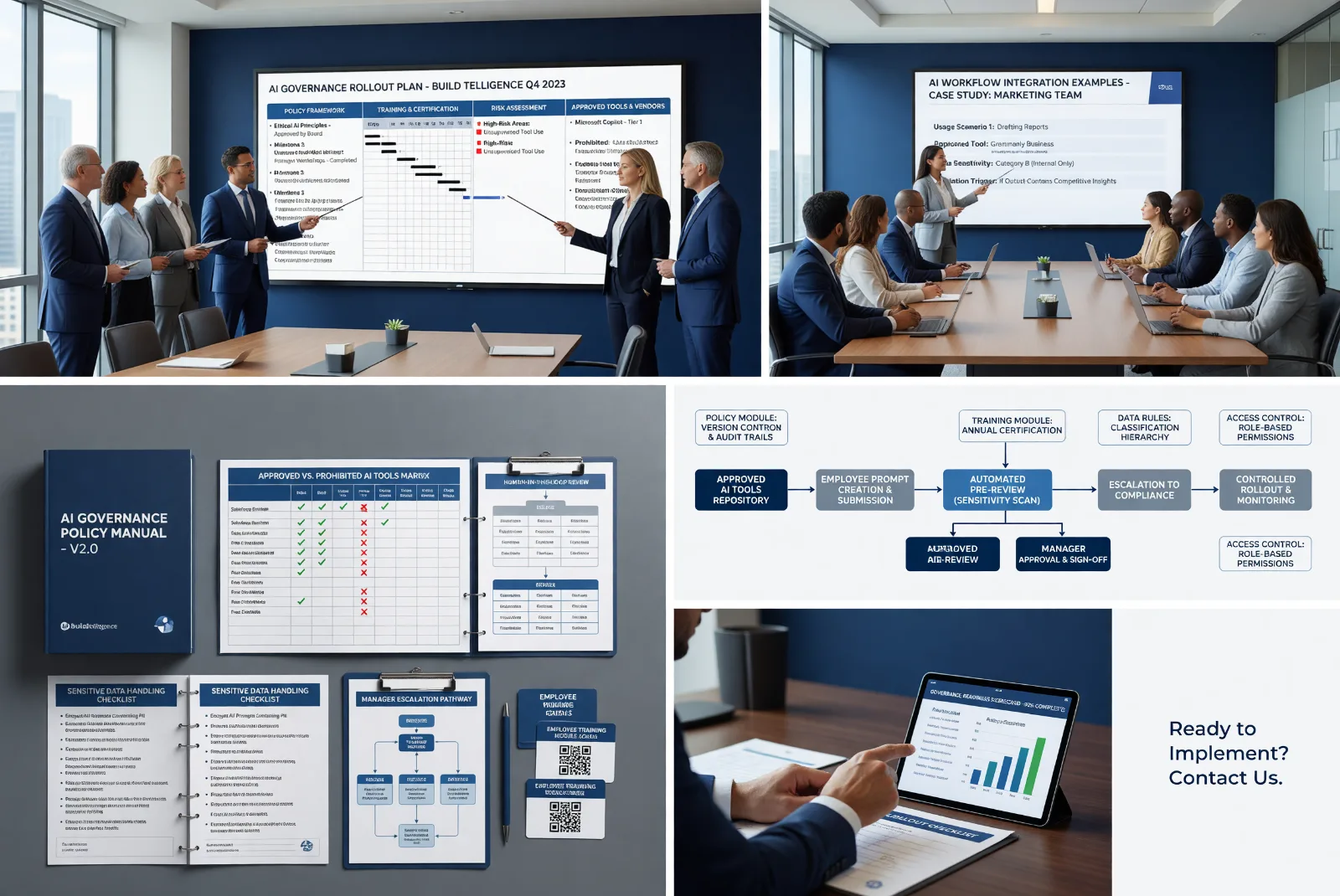
governance and training help companies move from informal use to responsible adoption. Buildtelligence helps define the rules, train the team, connect governance to workflows, and support implementation.