
AI Readiness Assessment
Get a Clear View of Where You Stand With AI
An AI readiness assessment is the most practical first step for most companies. It surfaces what AI activity is already happening, where the highest-value opportunities are, what governance gaps exist, and what the most realistic next step looks like. Buildtelligence delivers structured assessments designed to give leadership a grounded view. Not a sales pitch.
What does the readiness assessment cover? How long does an assessment take?
Why Start With an Assessment
Most AI initiatives stall not because the technology is wrong, but because the company moves before it understands its own readiness. Tools get purchased before workflows are mapped. Pilots get launched before governance exists. Use cases get prioritized based on excitement instead of operational fit.
An assessment prevents those mistakes. It establishes a clear baseline of what is already happening, what is working, what is risky, and what should happen next. Before significant time, budget, or political capital gets committed.
The output is not a generic AI report. It is a focused view of your company’s specific operating context, the realistic opportunities, the risks that need attention, and a prioritized recommendation for the most practical first move.
What the Assessment Covers
Eight dimensions of AI readiness, evaluated in your specific operating context.
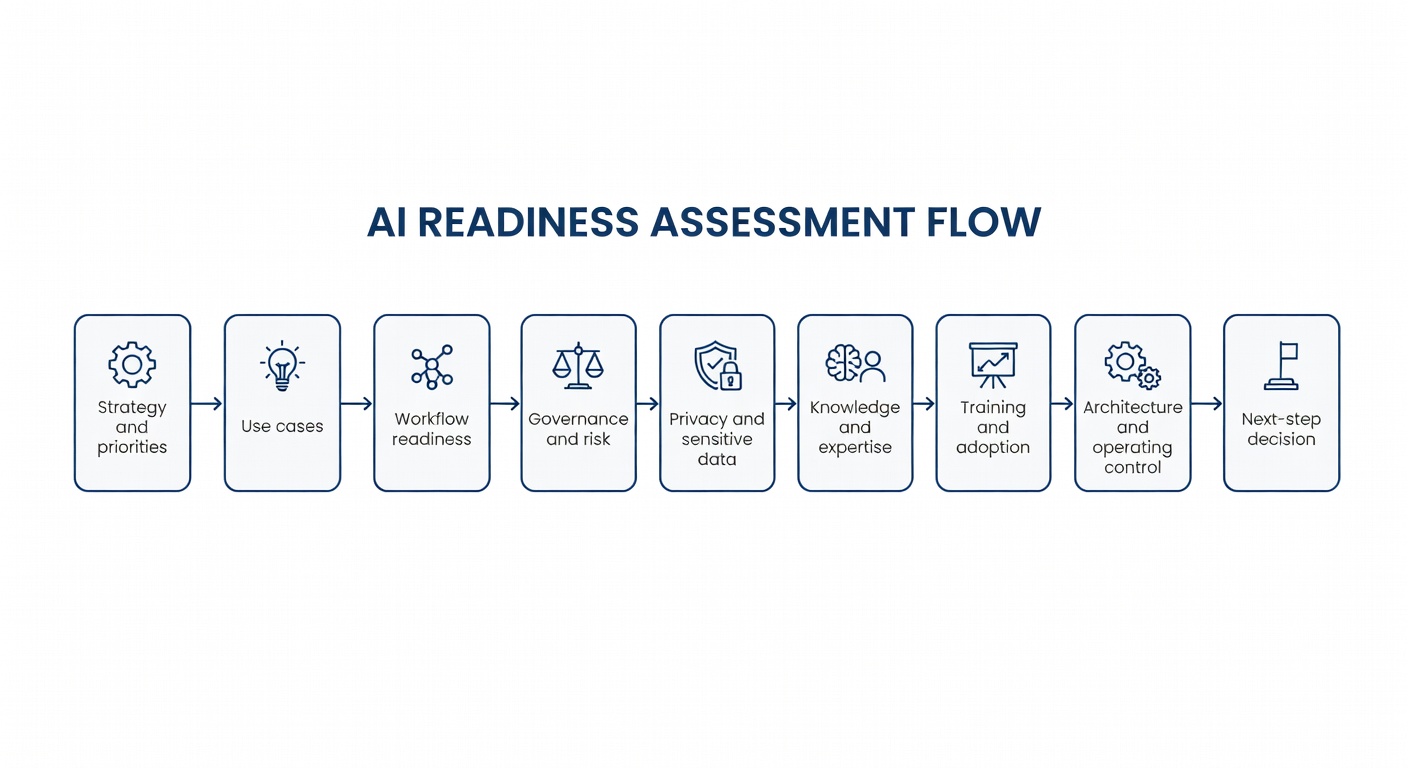
Current Activity
Which AI tools are being used, by whom, for what purpose. Both approved and informal usage.
Use Case Opportunities
Where AI could create real business value based on actual workflows, not generic industry trends.
Governance Gaps
What policies, access rules, or review processes are missing. And where current rules are not being followed.
Data & Privacy Risks
Where sensitive information may be moving into AI tools without controls, audit trails, or proper handling.
Team Readiness
What training, role clarity, and organizational support exist for the people expected to use AI.
Knowledge Architecture
How internal information lives, how findable it is, and whether AI could effectively access it.
Operating Environment
Whether your current tools, infrastructure, and integrations can support repeatable AI workflows.
Leadership Alignment
Whether decision-makers share a common view of priorities, ownership, risk tolerance, and success criteria.
How the Assessment Works
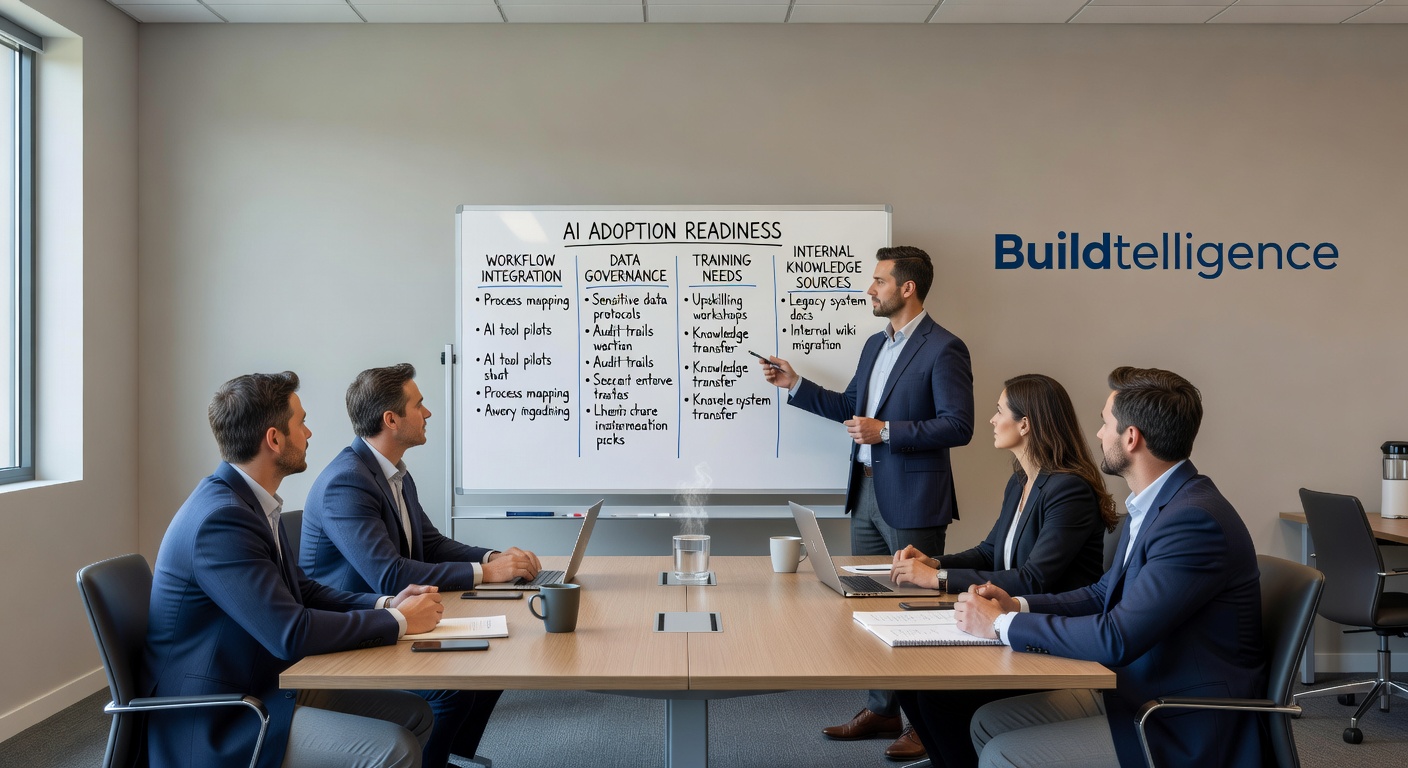
A structured four-phase process. Typically two to four weeks, depending on company size and scope.
Phase 1
Discovery
Establish context. What are the business priorities, the operating model, the technology stack, the existing AI activity, and the leadership questions driving the assessment.
Phase 2
Stakeholder Interviews
Structured conversations with leadership, department heads, IT, operations, and frontline employees. Surface what is actually happening, not just what the org chart suggests.
Phase 3
Analysis & Synthesis
Score each dimension. Identify patterns across teams. Map opportunities against feasibility, governance, and risk. Compare current state to a practical target state.
Phase 4
Roadmap & Readout
Deliver findings, prioritized recommendations, and a phased roadmap. Walk through it with leadership. The output is decision-ready, not just a document.

What You Get
Decision-ready deliverables that move you from uncertainty to a concrete next step.
- A current-state assessment of AI activity, tools, and informal usage
- A scored maturity view across the eight readiness dimensions
- A prioritized list of practical AI use case opportunities
- A risk register covering governance, data, and operational concerns
- A phased adoption roadmap with a clearly recommended first move
- Workflow opportunity mapping where applicable
- Governance and policy gap recommendations
- Tool, architecture, and operating-environment observations
- A leadership-level summary suitable for executive review
- A live readout session to walk through findings and answer questions
When This Is the Right Step
- Leadership wants to invest in AI but is unsure where to start
- Multiple departments are experimenting independently and you need a unified view
- You are evaluating tools or vendors and want context before committing
- Governance concerns are creating hesitation across the organization
- An earlier AI initiative stalled and you need a grounded reset
- You want a defensible internal recommendation backed by structured analysis
When This Is Not the Right Fit
- You already know exactly which workflow to implement and need execution support. Go directly to AI implementation
- You want validation of a decision that has already been made without genuine review
- The organization is not willing to participate in interviews or share operating context
- You are looking for a vendor pitch rather than independent analysis
An assessment is most valuable when there is real uncertainty to resolve. If you already have clarity, skip ahead.
Frequently Asked Questions
How long does an AI readiness assessment take?
Typically two to four weeks from kickoff to readout, depending on company size, the number of departments involved, and the scope of existing AI activity.
Who needs to participate?
Leadership, IT, operations, and one or two frontline users from each department where AI is being used or considered. Most companies need five to twelve interviews depending on size.
Do we need to have AI activity already happening?
No. The assessment works for companies just exploring AI as well as companies with extensive informal usage. The questions and emphasis adjust based on where you are.
What does the assessment cost?
Pricing depends on company size, scope, and the number of departments involved. Contact Buildtelligence for a scoped proposal after an initial conversation.
Will the assessment recommend specific tools or vendors?
The assessment may identify tool categories or capabilities that fit your situation, but Buildtelligence does not resell vendor products. Recommendations are based on operating fit, not commercial relationships.
Is the readout confidential?
Yes. All findings, interviews, and deliverables are treated as confidential to your organization. Specific terms can be detailed in the engagement agreement.
What happens after the assessment?
The roadmap is yours to execute. Buildtelligence can support follow-on work. Consulting, implementation, governance, training, or ThinkFreely planning. But there is no obligation to continue.
Can the assessment be done remotely?
Yes. Most engagements are conducted remotely. On-site work can be scheduled if helpful, but it is not required.
Schedule Your AI Readiness Assessment
A structured assessment is the most reliable way to turn AI uncertainty into a defensible plan. Schedule a conversation to scope your assessment.