
AI Workflow Implementation
Turn AI Ideas Into Working Business Workflows
AI workflow implementation helps companies turn AI ideas into structured business processes that employees can actually use. Many organizations can identify places where AI might help, but they struggle to define the workflow, assign ownership, govern usage, train the team, and measure whether the new process is working. Buildtelligence helps mid-sized companies design and implement AI workflows that connect strategy, people, systems, governance, and practical execution.
How does a manual workflow become AI-supported? Where does human review fit in?
Why AI Ideas Fail Without Workflows
AI ideas are easy to generate. A team may see opportunities to summarize documents, support customer service, prepare reports, answer internal questions, draft communications, analyze data, or automate repeated steps. But ideas do not become value until they become workflows.
A workflow defines how the work actually happens. It clarifies who starts the process, what information is required, where AI assists, what output is expected, what human review is needed, how exceptions are handled, and how the result moves to the next step.
AI skills define repeatable task behavior. AI workflow implementation defines how that task fits into the larger business process. AI workflow implementation turns AI from a useful idea into an operating process.
Workflow Opportunities
Good AI workflow opportunities usually appear where work is repetitive, knowledge-heavy, document-driven, or slowed by manual handoffs.
- Internal research and briefing
- Customer response drafting
- Support ticket triage
- Sales preparation and follow-up
- Proposal or scope development
- Executive reporting
- Internal knowledge retrieval
- Policy and SOP assistance
- Content review and drafting
- Operations documentation
- Quality review support
- Meeting-note summarization
- Intake review and routing
- Compliance-sensitive review preparation
What We Build
The deliverable is not just a prompt or a tool recommendation. It is a defined operating process. Depending on the use case, we may help build:
- Workflow maps
- AI-assisted task steps
- Role and ownership definitions
- Required input rules
- Approved source material guidance
- AI skill instructions
- Output formats
- Review and approval steps
- Escalation logic
- Governance and privacy rules
- Training materials
- Usage and performance measures
- ThinkFreely requirements where stronger control is needed
Implementation Process
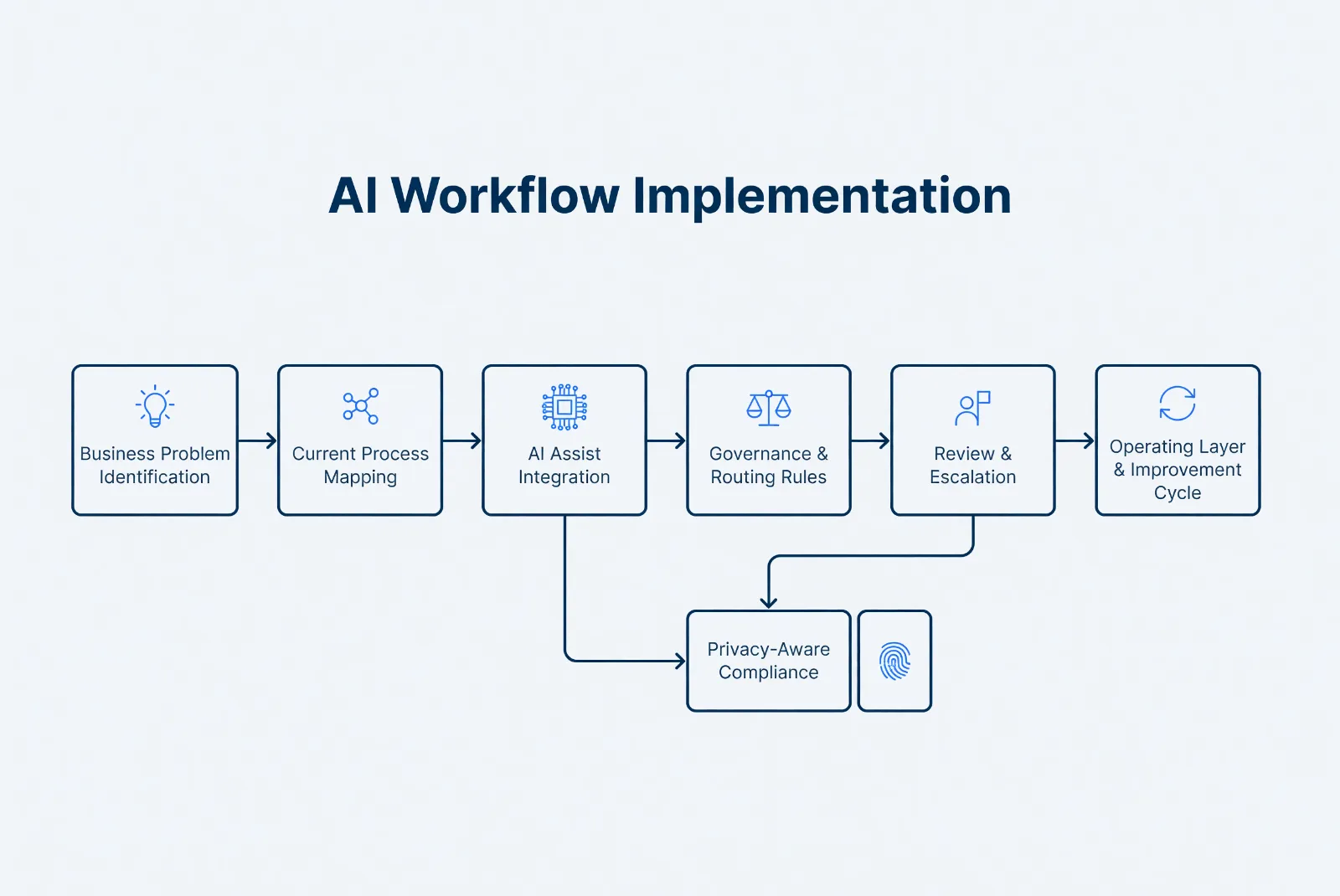
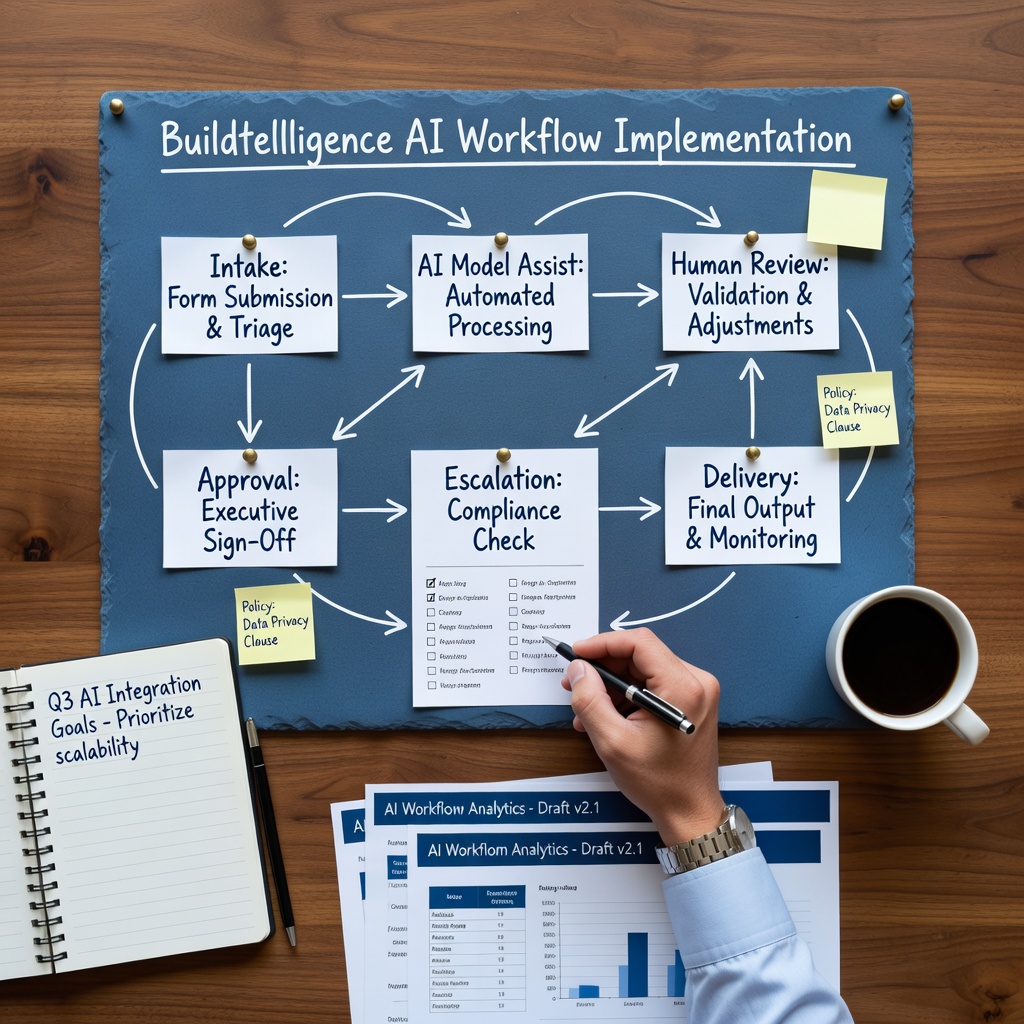
A structured process to move from workflow idea to practical implementation:
- Define the workflow problem. Identify what is slow, inconsistent, or overly dependent on individual effort
- Map the current process. Who does the work, what information they use, where delays happen, where review or escalation occurs
- Identify where AI should assist. Summarizing, classifying, drafting, comparing, extracting, routing, checking
- Define the AI skill. Instructions, source material, output format, review requirements, governance boundaries
- Build governance into the workflow. What data can be used, which outputs require review, what should be escalated
- Evaluate the operating environment. Whether ThinkFreely is needed for routing, privacy, queueing, failover, or instruction stability
- Train, launch, and improve. Define training, launch steps, review expectations, and improvement loops

Frequently Asked Questions
What is AI workflow implementation?
AI workflow implementation is the process of designing and launching business workflows that use AI in a structured, governed, and repeatable way. It includes workflow mapping, task design, AI skill creation, review steps, governance rules, training, and improvement planning.
How is AI workflow implementation different from AI implementation?
AI implementation is the broader process of moving AI from strategy into working systems. AI workflow implementation focuses specifically on designing and implementing the workflows where AI will support actual business tasks.
How is AI workflow implementation different from AI skills?
workflow implementation defines the broader process. AI skills define the repeatable AI-supported task behavior inside that process. A workflow may include one or more skills.
What types of workflows can AI support?
AI can support workflows involving research, reporting, support triage, sales preparation, customer communication, document review, internal knowledge access, operations documentation, training, and recurring decision support.
When does an AI workflow need ThinkFreely?
An AI workflow may need ThinkFreely when it requires stronger routing, privacy-aware handling, usage visibility, priority queueing, failover, or instruction stability than the existing environment provides.
Can Buildtelligence capture the way our best people already do the work?
Yes. Buildtelligence can help extract workflow knowledge from executives, managers, subject-matter experts, and key employees, then translate that knowledge into process maps, AI skills, review rules, and governance boundaries.
Is workflow implementation the same as automation?
Not always. Some workflows may include automation, but many AI workflows are assistive. The goal is to improve the process with the right balance of AI support, human review, governance, and system integration.
Can Buildtelligence help improve a workflow we already started?
Yes. Buildtelligence can review an existing AI-supported workflow, identify what is working, find gaps in process or governance, and recommend changes to improve consistency, adoption, and value.
Do AI workflows replace employees?
No. AI workflows are designed to support work, not eliminate judgment. Human review, escalation, oversight, and refinement remain important, especially for sensitive, client-facing, or high-value processes.

Build AI Workflows People Can Actually Use
workflow implementation turns ideas into operating processes. Buildtelligence helps define the workflow, structure the AI-supported tasks, capture human expertise, build governance into the process, and support rollout so teams can use AI consistently.