Between September 11–16, 2026, Washington’s AI-control debate moved from abstract risk language into interrupt language that operators can recognize. Reuters reported on September 11 that Senate negotiators were debating a duty of care for AI developers and a possible government path to block unsafe model releases, with court challenge options still under discussion. Nextgov/FCW reported on September 11 that Commerce-panel talks were split over who runs safety tests. On September 16, Nextgov/FCW covered House Democrats pressing leaders to stay and advance FRONTIER and kill-switch legislation, while Sen. John Kennedy’s office and The Hill described Kennedy’s failed unanimous-consent push for an AI Emergency Button Act after Sen. Rand Paul objected.
None of that is enacted law. All of it is a live signal about interrupt authority: throttle, suspend, halt, or shut down advanced model paths when catastrophic-risk or emergency language is invoked. Buildtelligence’s operating question is not whether Congress should pass any particular bill. It is whether mid-market and public-sector operators can survive an interrupt without becoming an outage: if a frontier model must come offline, can the workload move?
Buildtelligence helps organizations use AI without losing control of cost, data, workflows, or vendor choice. The category that fits this Hill wave is AI Operating Control: inventory of what runs where, monitoring and audit of what already ran, revoke paths that actually cut access, and failover to another approved model so continuity does not depend on a single frontier endpoint.
What mid-September actually put on the table
Start with the House kill-switch track already on Congress.gov. H.R. 9917, the AI Kill Switch Act, was introduced July 23, 2026 by Rep. Ted Lieu (D-CA) for himself and Rep. Nathaniel Moran (R-TX), and referred to Homeland Security, with subcommittee referral to Cybersecurity and Infrastructure Protection around July 24. The short title is the AI Kill Switch Act. The introduced text would amend the Homeland Security Act to require covered entities to maintain technical capability to stop inference, terminate or suspend user access, and shut down covered technology, with a graduated framework that contemplates throttling inference rate, user access, or compute allocation, disabling capabilities, suspending or shutting down the technology, and transitioning dependent operations to a backup system or earlier version. Covered-entity and covered-technology definitions in the introduced text are set by revenue and compute-cost thresholds and by later rulemaking; this draft will not treat those thresholds as settled policy. H.R. 9917 is introduced legislation, not a signed mandate.
The Senate floor flash on September 16 was different in sponsor and mechanism, but it rhymes on interrupt. Kennedy sought unanimous consent for his AI Emergency Button Act to require advanced AI developers to install an emergency kill switch. Paul objected, so the bill did not advance via unanimous consent. Kennedy’s own framing, in his September 16 release and in Hill coverage, puts the companies, not the government, in charge of using the emergency shutoff. Paul, per The Hill and corroborating coverage including Anadolu Agency, warned that an open-ended mandate could harm AI use across the economy, proposed a bipartisan study committee, and objected after Kennedy rejected that modification.
House pressure the same day kept FRONTIER in the same frame. Nextgov/FCW reported that Reps. Don Beyer, Lori Trahan, Ted Lieu, and Sara Jacobs pressed House leaders to cancel or shorten recess and legislate on AI, naming Trahan’s FRONTIER Act (coauthored with Rep. Jay Obernolte) and Lieu’s kill-switch track among the ready proposals. H.R. 9925, the FRONTIER Act, was introduced July 23, 2026 by Obernolte for himself with original cosponsors including Trahan, Erin Houchin, Scott Peters, Scott Franklin of Florida, and Suhas Subramanyam. Trahan, in Nextgov’s account, described FRONTIER as focusing on transparency in model design and capabilities, independent audits, compulsory incident reporting, and a court-backed process for the government to halt model deployment and development if it is determined to pose a threat. That is coverage attribution, not a claim that final section language has been enacted.
Senate Commerce talks supply the duty-of-care lane. Reuters, citing two Senate aides and a lobbyist involved in the talks, said negotiators were considering a duty of care for AI developers to design against catastrophic risks, with possible government power to block release of certain models and a federal-court challenge path still being structured. Talks involve Majority Leader John Thune, Commerce Chairman Ted Cruz, and Sen. Amy Klobuchar; Sen. Maria Cantwell has also weighed in. Nextgov/FCW, citing people familiar and a Democratic committee aide, reported the testing dispute: company-led tests presented to Commerce versus Cantwell’s preference for mandatory testing and vetting through national labs and national-security agencies. No final bill text is public in these accounts, and no deal is closed here.
Interrupt without replaceability is the operator gap
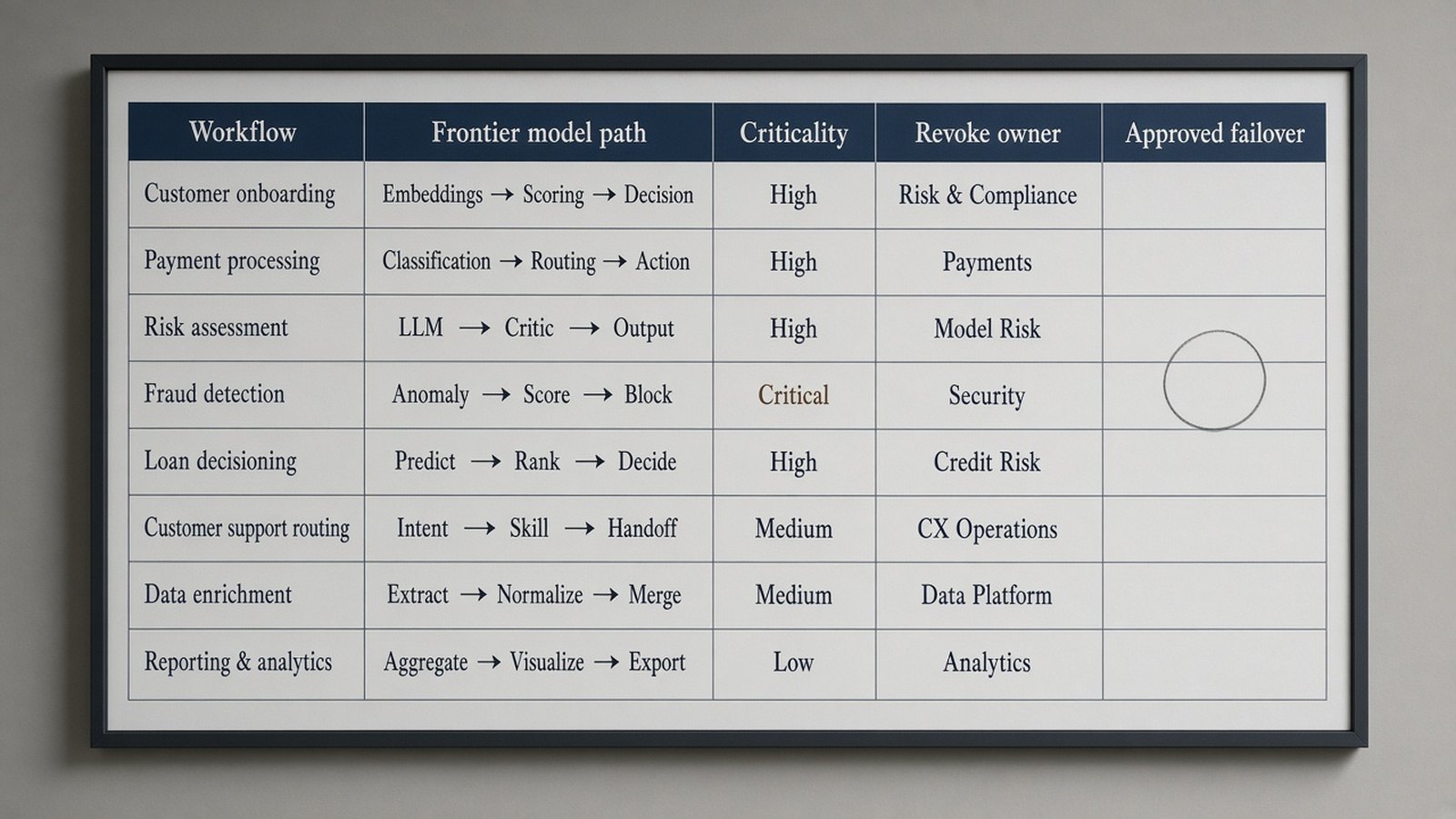
For a lab or a covered developer, “maintain a kill switch” or “accept a halt order” is a product and compliance problem. For the buyer that already wired customer service, claims review, permitting intake, research summarization, or cyber triage to a single frontier endpoint, the same interrupt is a continuity problem.
If a model must throttle or suspend, five questions decide whether the organization stays up:
- Inventory. Which workflows, agents, plugins, and API keys depend on that model today, including shadow tools?
- Monitoring. Can operations see latency, error spikes, and policy triggers in time to act, or only after users report failure?
- Audit trails. What ran on that path in the last hours and days: prompt classes, tool calls, outputs that entered records systems?
- Revoke paths. Can access be cut by application, team, and key without waiting for a vendor portal scramble?
- Failover. Is there another approved model path with comparable policy, data boundaries, and runbooks, or is “approved” a synonym for one brand?
Interrupt without replaceability is the gap. A shutdown capability upstream does not invent inventory, revoke, audit, or failover downstream. Organizations that treat frontier access as a single pipe discover that fact the hard way.
This is not an argument against regulation, and it is not an argument against frontier labs shipping capable models. Both can be true: public safety debates will keep producing interrupt language, and operators still have to own replaceability. Continuity is the buyer’s problem even when the switch sits with a company, a court, or a department.
What AI Operating Control would have changed in this news situation
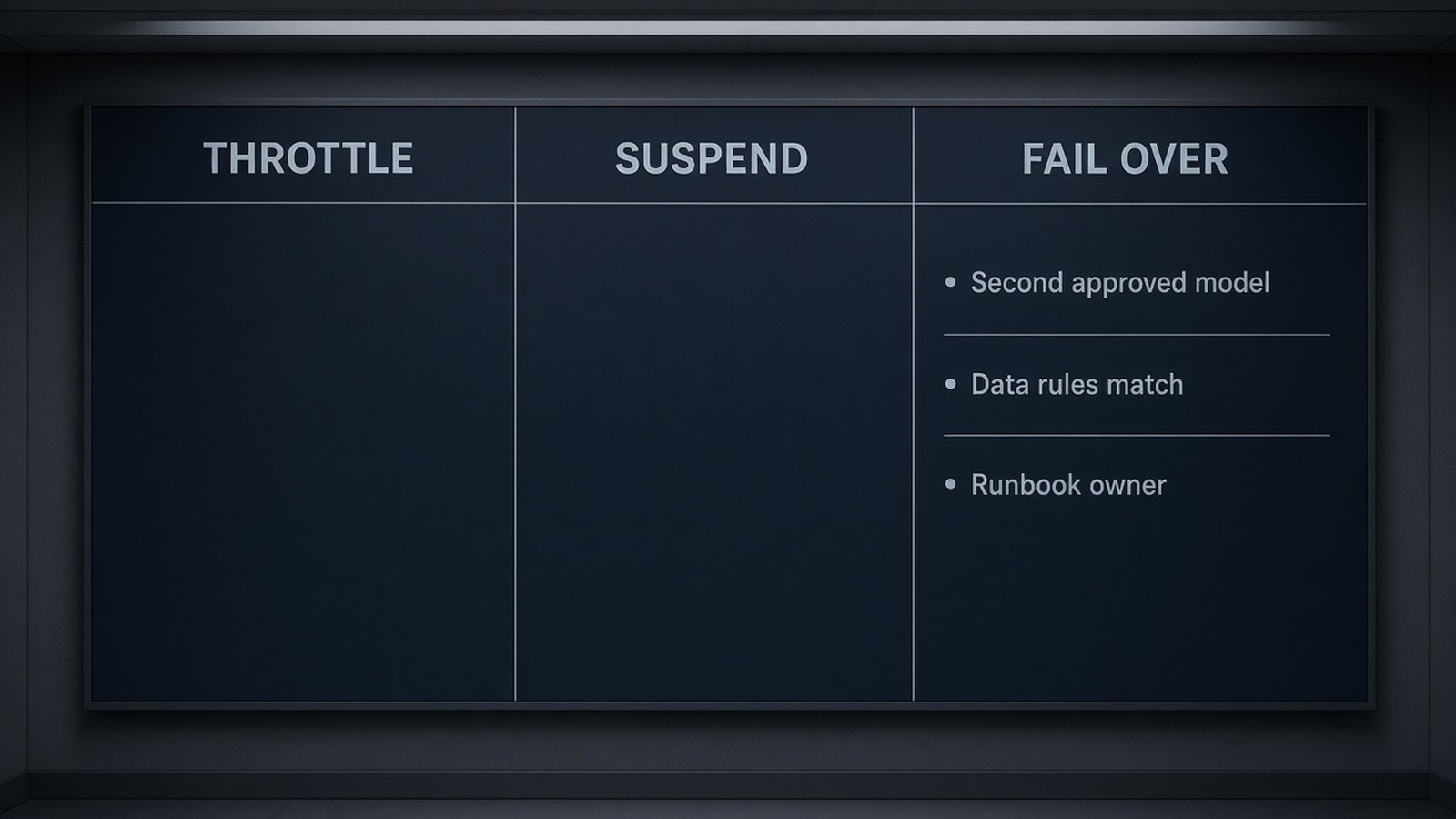
Map the mid-September stack onto operating control without pretending any bill already forces buyer-side controls.
If H.R. 9917-style shutdown, throttle, or suspend capabilities ever bind covered technology that an organization depends on, the buyer still needs to know which of its workloads sit on that technology. Graduated measures in the introduced House text explicitly contemplate transitioning dependent operations to a backup system or earlier version. That sentence only helps operators who already named the dependent operations and the backup.
If a Kennedy-style company-held emergency button is ever used, the interrupt may arrive as a vendor action, not a federal login. Buyers without revoke and failover still experience it as sudden unavailability. Company-held does not mean buyer-ready.
If FRONTIER-style transparency, audits, incident reporting, and a court-backed halt process advance, halt language will matter most to organizations that can prove what they ran, what they stopped, and where work moved. Incident reporting upstream does not create buyer audit trails.
If Senate duty-of-care and possible Commerce-linked block-and-court paths advance, release decisions may slow or stop a model path. Organizations that cannot fail over will treat a pre-release block as abstract, and a post-adoption suspend as an outage.
In each lane, AI Operating Control is the missing buyer layer: not a second legislature, and not a product dunk. It is the practical stack that makes interrupt survivable.
What operators need before interrupt becomes outage
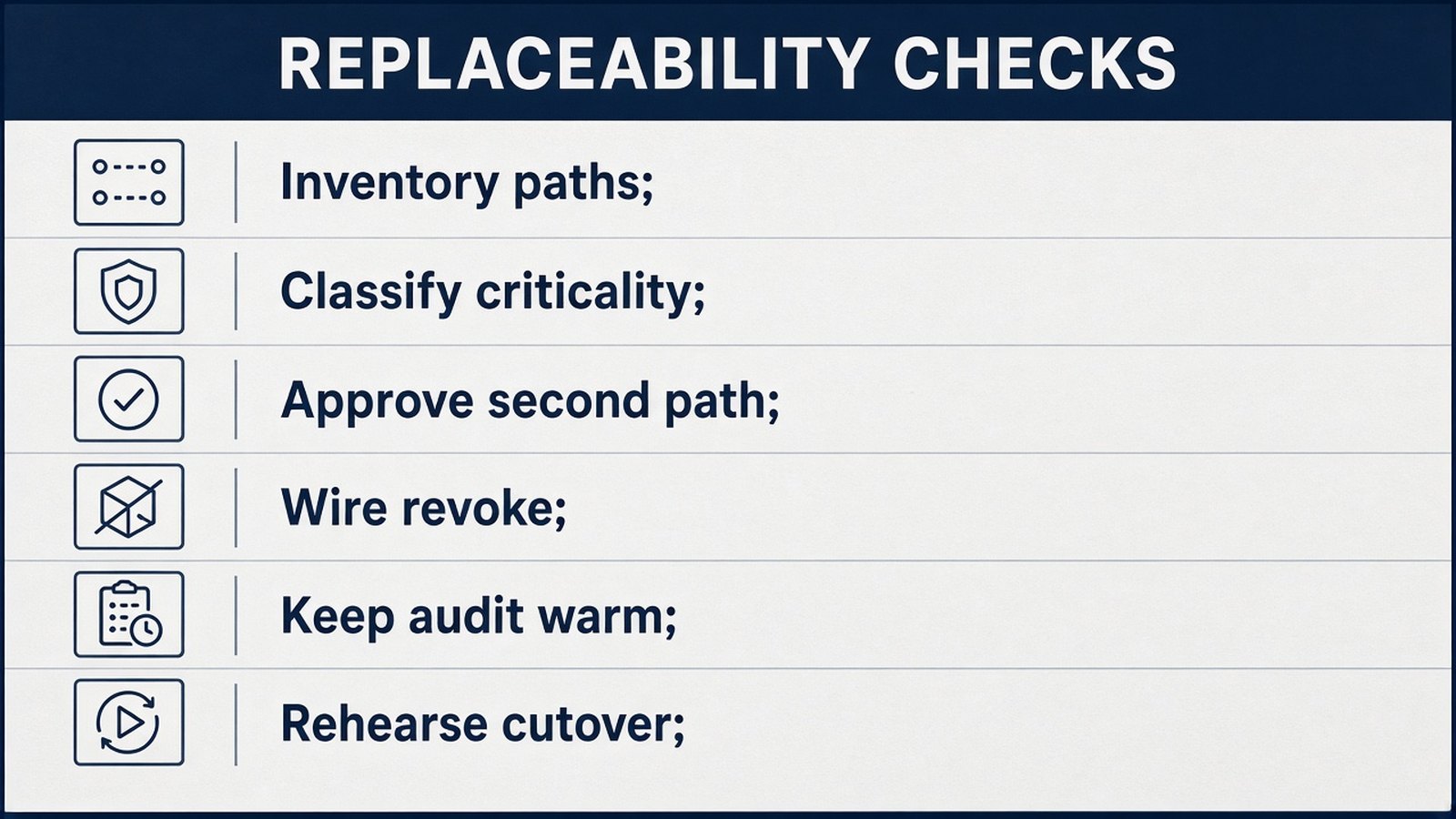
Moving from scattered AI activity to governed implementation starts with replaceability drills, not with waiting for final conference language.
Before the next frontier dependency hardens:
- Name the map. List every production and near-production path that calls a frontier model. Include embedded assistants and vendor features that quietly route to the same endpoint.
- Classify criticality. Mark which paths can pause for a day, which need minutes-level failover, and which must not touch a single-vendor frontier model at all.
- Approve a second path. For each critical class, designate another approved model or constrained workflow with written data and retention rules. “We will figure it out” is not a failover.
- Wire revoke. Make sure application owners can disable keys, roles, and agent tools without a war-room hunt.
- Keep audit warm. Retain enough request and tool-call evidence to answer what ran if a suspend order, vendor emergency action, or incident report lands tomorrow.
- Rehearse the cutover. Run a scheduled failover test the way operators already test DNS or payment-processor fallback. Measure time to restore, not slide-deck confidence.
None of that requires inventing a federal deal that has not closed. It does require treating mid-September’s interrupt vocabulary as an operating input. Kill-switch bills, FRONTIER halt language, and duty-of-care block talks are upstream signals. Downstream, the durable question remains: when a frontier model must come offline, can the workload move?
If the honest answer is no, talk through the operating questions before the next critical workflow is pinned to a single frontier path that cannot be inventoried, revoked, audited, or replaced under pressure.