On 26 June 2026, Forbes reported that OpenAI was rolling out GPT-5.6 as three models, and that access would start with a limited set of “trusted partners” after a U.S. government request, not with a broad cutover. That is the news. The operating problem, two months later, is what happened once the gate opened.
Most mid-sized companies and Florida public agencies did not spend June arguing about model names. They spent it discovering that the next flagship might not be on the price list, the approved-vendor list, or the API string they already coded. When GPT-5.6 reached general availability on 9 July, the default was no longer one model. It was three named tiers plus an unsuffixed alias that still bills like the expensive one. If you cannot route, you will overpay. If you cannot fail over, you will wait.
That is an operating-control problem: cost, availability, and vendor choice sitting in the same ungoverned cutover. AI Operating Control, in this case, means naming the model before the invoice names it for you.
The June gate was the story. The July default is the bill.
Forbes described a Friday rollout of Sol as the flagship, Terra for daily work, and Luna as the more affordable option, with a broader release promised for the coming weeks. OpenAI’s own preview post, the same day, is more precise about the guest list. The company said it had previewed plans and capabilities with the U.S. government and, “at their request,” was starting “with a limited preview for a small group of trusted partners whose participation has been shared with the government.” During that window the models were initially available through the API and Codex to that group, not to ChatGPT at large.
OpenAI also said it does not believe “this kind of government access process should become the long-term default,” because it keeps the best tools from users, developers, enterprises, cyber defenders, and global partners. Treat that as a company position. OpenAI called the preview list a small group. Secondary write-ups floated a headcount. The company post does not, so this desk will not. If you were not on the shared list, the new flagship was not a product you could buy, route, or defend in a board packet.
Three models is a routing decision, not a feature dump.
When OpenAI moved the family to general availability on 9 July 2026, it kept three durable capability tiers. Sol is the flagship. Terra is the balanced model OpenAI positions for everyday work, and the company has described it as competitive with GPT-5.5 at a lower cost. Luna is the fast, low-cost tier for high-volume work. Those are OpenAI’s labels, not independent tests.
Reuters reported on 8 July that OpenAI would launch Sol, Terra, and Luna publicly the following day, after the government-requested delay and after Axios had reported that the administration had cleared a broader launch following additional testing. The control question is which workflows get which tier once every developer, licensed assistant, and vendor connector can see the new names.
Reserve premium models for premium work. A records-request summary, a help-desk classification, and a high-stakes contract review are not the same job. Sending all three to Sol is an ungoverned architecture. Sending all three to Luna is a quality gamble you should be able to name. Write the map: this class may use Sol, this class should use Terra, this class should use Luna, and this class should not leave the building.
OpenAI’s current API rate card, checked on 27 August 2026, makes the map dollar-visible. On the company’s published pricing page, short-context rates per million tokens are $4.00 input and $20.00 output for gpt-5.6-sol, $2.00 and $12.00 for gpt-5.6-terra, and $0.20 and $1.20 for gpt-5.6-luna. Sol’s promotional pricing is listed as available at least through 21 November 2026. Long-context prompts are billed higher. Those figures will move. They are not a savings guarantee. They are why an ungoverned default is a finance event.
The gpt-5.6 alias is a silent cutover.
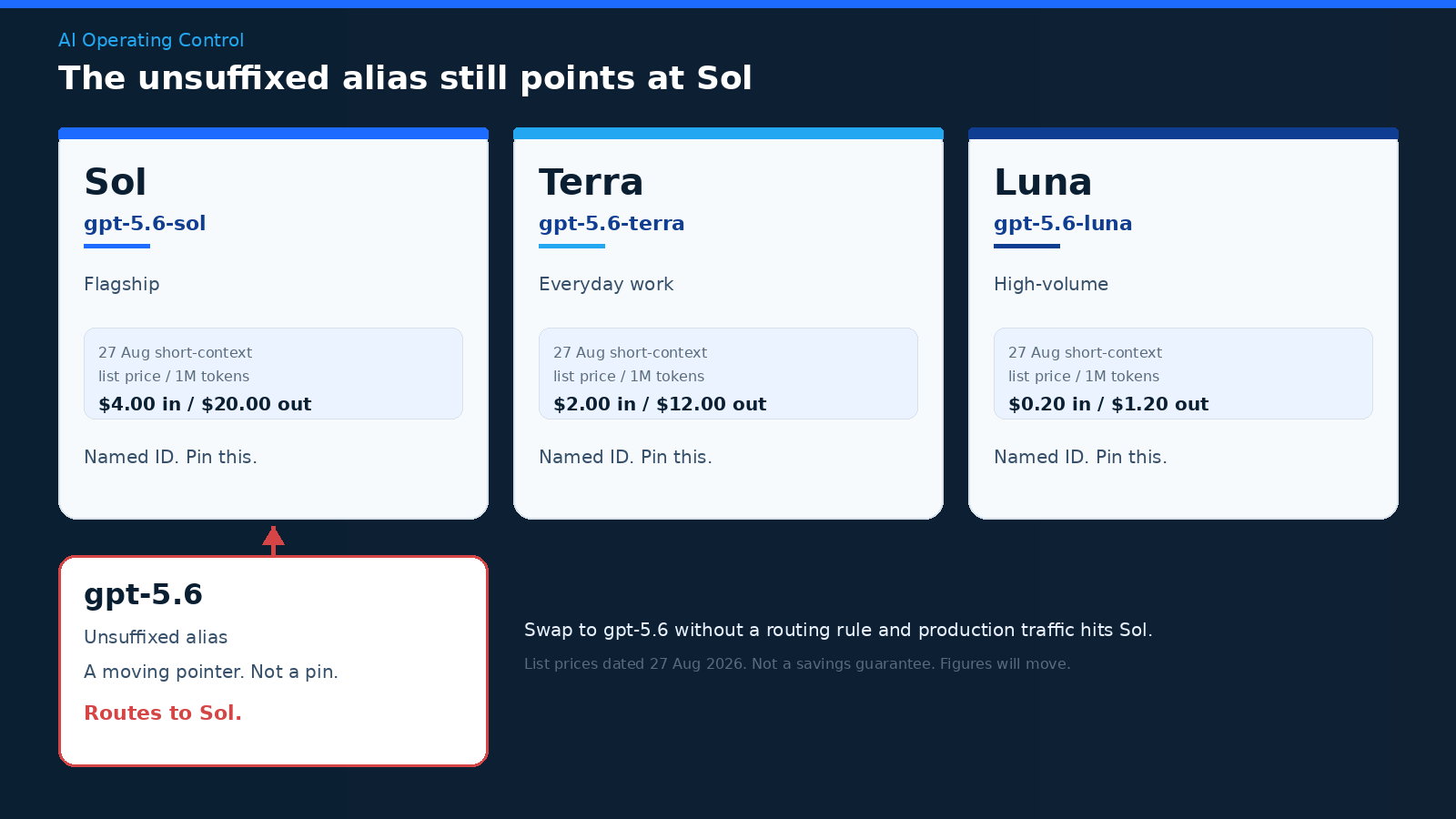
OpenAI’s API documentation is blunt. GPT-5.6 Sol “roughly corresponds to the unsuffixed model tier used in earlier GPT-5 families.” The gpt-5.6 alias routes requests to Sol.
That is the cost event. Teams that “upgrade to 5.6” by swapping a model string, without changing routing policy, are pointing production traffic at Sol. Invoices then look like a price hike even when Terra or Luna would have done the job. Developers did not necessarily choose the expensive path. The alias did.
Pin named models in code, in procurement language, and in the vendor’s admin console. gpt-5.6-sol, gpt-5.6-terra, and gpt-5.6-luna are choices you can audit. gpt-5.6 is a moving pointer. If a SaaS tool you already pay for exposes only the unsuffixed name, ask which underlying model it calls, what you are billed, and whether you can set a cheaper default.
ChatGPT access is not a single switch. OpenAI’s general-availability post says Plus, Pro, Business, and Enterprise users access Sol in chat at medium and higher effort, while Free and Go users on ChatGPT Work and Codex access Terra. After 9 July, “we have GPT-5.6” can mean three different things in the same organization. Inventory the seats.
Availability is now a political variable.

The June preview sat inside a federal process that is voluntary on paper and a bottleneck in practice. AP reported that President Trump signed an executive order establishing a framework for the government to vet national-security risks of the most advanced AI systems for up to a month before public release, with participation described as voluntary and a 30-day review clock. The White House, as quoted by AP, said the administration is “NOT conducting oversight of all new models.”
Reuters, summarizing the July reopening, said access had been limited to vetted partners whose details were shared with the authorities after a government-requested delay. None of that is a reason to boycott OpenAI. It is a reason to stop treating last quarter’s flagship as a utility.
Buildtelligence is not against AI vendors. Buildtelligence is against unmanaged dependence. If a future flagship can be held to a Washington guest list, a Florida county that put production workflows on a single frontier API, and a mid-market firm that did the same through one cloud marketplace, both bought a single point of delay. The companion lesson from June’s Anthropic export-control outage is the same shape: when access is a policy instrument, failover is an operating requirement.
Public agencies feel this first in procurement and records. You cannot put “whatever OpenAI is calling the default this week” in a contract and call it a model. You need named models, named data boundaries, and a written fallback. Enterprises feel it in the budget calendar. A two-week gate is a sprint delay. An ungoverned alias is a quarter’s variance.
Washington did not certify the model for you.
Axios reported that the broader July launch followed a “green light” from the administration after testing with the Commerce Department’s Center for AI Standards and Innovation. That is the claim the wires repeated. It is not a safety badge you can file.
On 8 July, a White House spokesperson told Gizmodo the opposite of a clearance: “The Trump administration did NOT give OpenAI a ‘green light,’ approval, or clearance to release its models.” The spokesperson added, “No such permission is required or granted,” and that decisions on timing and scope “rest entirely with the companies.” CNBC reported the same denial that day. Gizmodo also quoted the June 2 order as saying the voluntary framework would not include a mandatory governmental licensing, preclearance, or permitting requirement for releasing new models.
Do not treat the June preview, the Commerce testing, or the July launch as a federal safety clearance. Government involvement is not your vendor’s quality stamp. If a salesperson tells a city manager or a CIO that GPT-5.6 “was approved by Washington,” ask them to show the instrument. The White House says it does not issue that instrument.
What to control before the next cutover
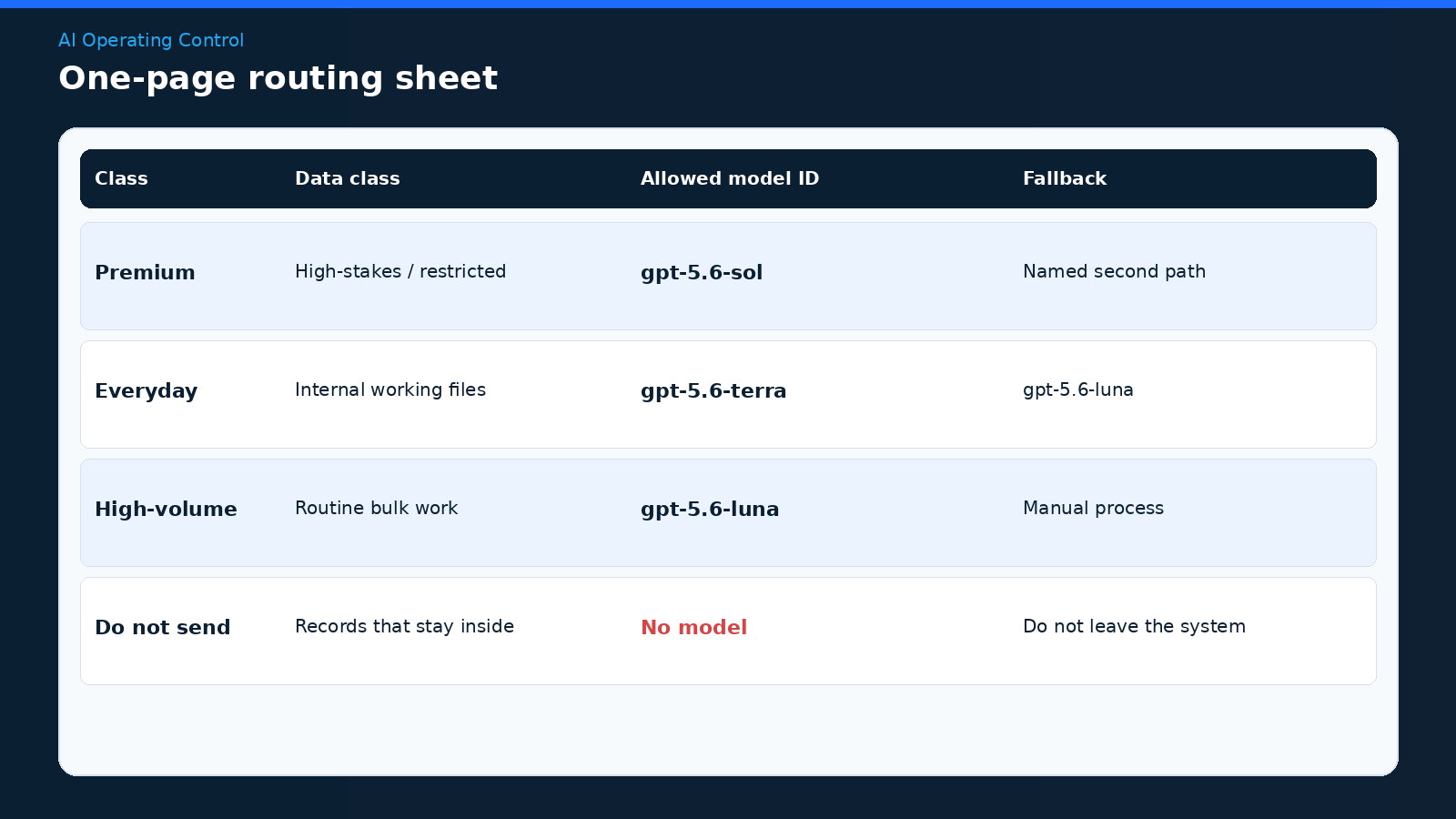
The useful work is the same whether the stack is OpenAI, another lab, a cloud marketplace, or a mix.
Inventory the strings. Where does gpt-5.6, gpt-5.6-sol, Terra, or Luna actually run: internal apps, a copilot in licensed software, a departmental ChatGPT workspace, a vendor’s “AI assistant” you cannot inspect? If you cannot name the model, you cannot name the cost. Shadow AI is the same failure with a different invoice.
Write the routing rule in one page. Which workflows are premium. Which are everyday. Which are high-volume. Which must not leave a records system. Attach a model, or a prohibition, to each class. “Use the default” is not a rule.
Pin versions where the vendor lets you. Give finance a rate-card habit. OpenAI cut Terra 20 percent and Luna 80 percent on 30 July, then dropped Sol’s API and credit pricing by more than 20 percent on a promotional window. Those company-announced changes help only if someone is watching which model the tokens hit. Keep a failover: another tier, another vendor, or a documented manual process. Unmanaged dependence is what you have when none of those exist.
This is implementation work, not a model recap. AI enablement here means moving from “we got access” to “we can see cost, data, workflows, and vendor choice.” Buildtelligence helps companies use AI without losing control of cost, data, workflows, or vendor choice. It implements whatever stack the engagement requires. ThinkFreely is a control layer we will recommend when it fits. It is not a requirement to hire us, and it is not the subject of this piece.
What this piece does not claim
This piece does not claim GPT-5.6 received a federal safety clearance. It does not reprint OpenAI’s benchmark charts as if we ran them. It does not assign a percentage savings to routing: list prices show a spread, and your mix decides the invoice. Routing can reduce spend relative to sending every task to Sol. It can also fail if you starve a workflow that needed the flagship. It is not legal advice on the executive order, and it is not an argument to drop OpenAI. The failure mode is the ungoverned default.
The next question
The gate opened on 9 July. The alias still points at Sol. The next frontier release will arrive with another guest list, another rate card, and another unsuffixed name that looks like an upgrade.
Can your organization name, today, which workflows actually need Sol, which can run on Terra or Luna, and what still gets done if Washington’s next preview does not include you?