A 12 June 2026 Commerce letter forced Anthropic to disable Fable 5 and Mythos 5 for every customer, turning a vendor default into a continuity and routing problem.
On 12 June 2026, CNBC reported that Anthropic had disabled Fable 5 and Mythos 5 after a U.S. government export-control directive citing “national security authorities.” The company said the order arrived at 5:21 p.m. ET that Friday. It required Anthropic to suspend access “by any foreign national, whether inside or outside the United States, including foreign national Anthropic employees.” Anthropic then took both models offline for every customer so it could comply. Other Anthropic models were not affected. If the newest model is how the work actually runs, that Friday night was not a product delay. It was a single point of failure.
The verified sequence is short and unforgiving
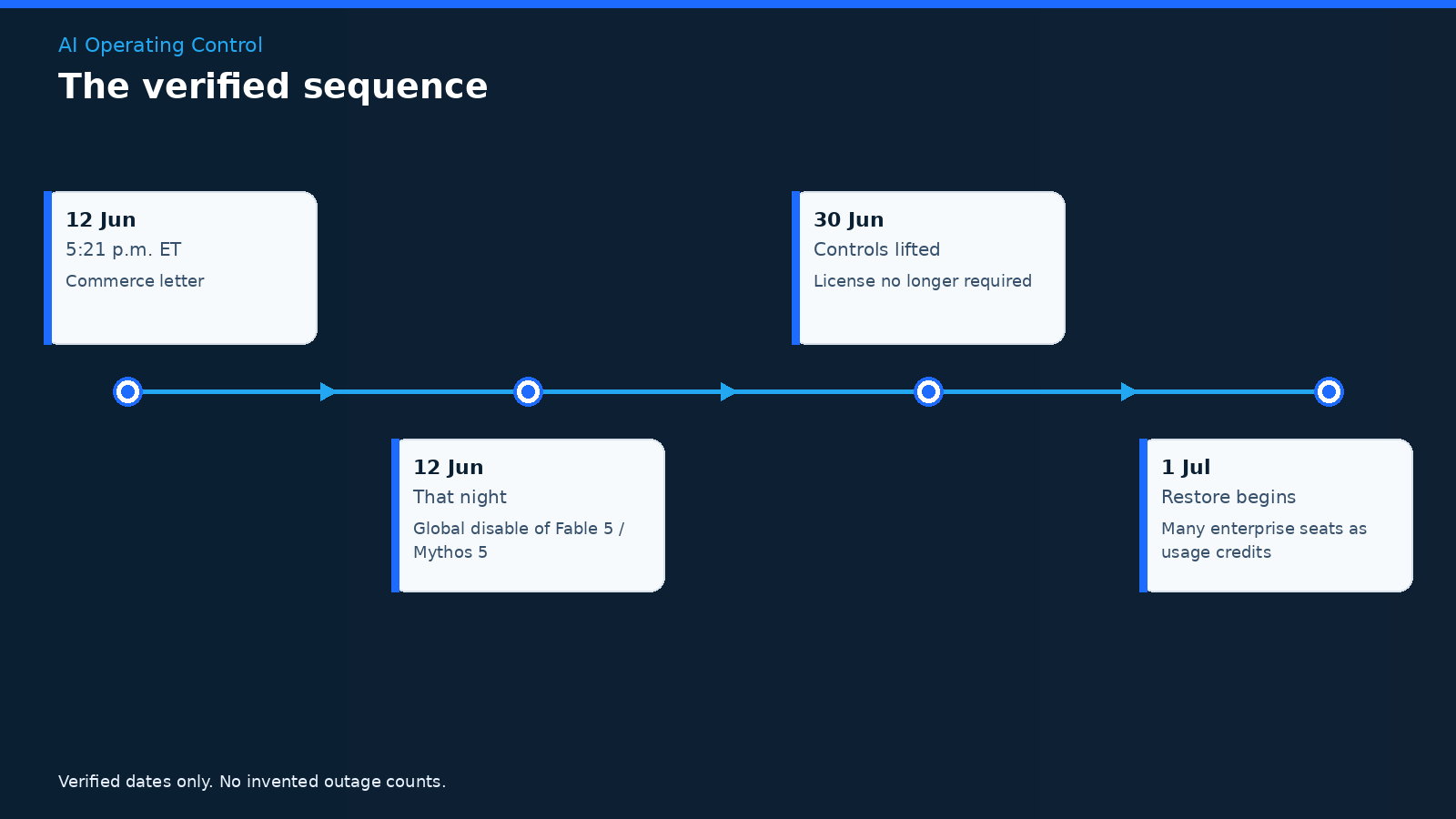
Axios reported the same day that Commerce Secretary Howard Lutnick sent the letter. Fable 5 and Mythos 5 would be subject to export controls for any location outside the United States and for all foreign persons inside the country. Axios said the letter required a license for export, re-export, or domestic transfer. Anthropic cut off all customer access that night.
Reuters, as carried by Yahoo Finance, reported that Anthropic would “abruptly disable” the models for all users. A U.S. official confirmed that Commerce had issued the directive. Reuters also reported that Amazon’s AWS unit said Anthropic had asked it to revoke access for “all users in all regions.”
CNBC placed the outage days after Anthropic had announced the two models. Fable 5 was the public offering. Mythos 5 was already limited.
In a 12 June statement, Anthropic said the letter did not provide specific details of the national security concern. The company said its understanding was that the government believed it had a method of bypassing, or “jailbreaking,” Fable 5, and it disagreed that a narrow potential jailbreak justified recalling a commercial model. It also wrote that it believed the episode was “a misunderstanding.” That is Anthropic’s statement, not a finding of this desk.
Nationality, not geography, is why everyone went dark
The letter covered foreign nationals inside the United States, including Anthropic’s own employees. A U.S. enterprise seat and a Florida county tenant were not the named targets. They were still in the blast radius.
Anthropic later wrote, in its 30 June redeployment post, that the order took effect immediately and that it had “no reliable way to verify nationality in real-time,” so it suspended both models for all users. Most identity systems know a user, a domain, and a role. They do not know citizenship on every request. Reuters quoted Dean Ball, a former White House official, saying customers should expect to have to prove citizenship to use the latest models. The Friday-night fact is simpler. The vendor could not sort users that way, so it turned the models off.
A hypothetical, not a client case and not a Florida outage count: a clerk’s office, a city budget shop, or a mid-market CIO has already made the newest model the default. None of those teams is running an export-control program. They still lost the model.
Buildtelligence is not against Anthropic, and it is not against frontier models. The failure mode is unmanaged dependence: the condition in which a vendor default becomes the architecture because nobody named a failover, a routing rule, or a second path.
Restoration did not put the prior default back
On 30 June 2026, CNBC reported that Commerce had lifted the export controls. Anthropic said Fable 5 would again be available to global users on the Claude platform, Claude.ai, and Claude Code starting Wednesday, 1 July. Reuters, as carried by Nikkei Asia, reported the same lift, and that a Lutnick letter seen by Reuters said a license was no longer required for export of the Mythos or Fable models.
Lutnick, as quoted in that Reuters copy, said Anthropic had agreed to detect and address security risks, work with the government on protocols and releases, and report malicious activity. CNBC reported that days earlier he had permitted Mythos 5 for certain “trusted partners.” Anthropic said it restored Mythos 5 for a set of U.S. organizations after approval on 26 June.
The restore still changed the commercial object. Anthropic’s 30 June post said that for Pro, Max, Team, and select Enterprise plans, Fable 5 would be included for up to 50 percent of weekly usage limits through 7 July, after which it would be available via usage credits. In a footnote, Anthropic said standard Enterprise seats had no included Fable 5 allowance. Access ran through usage credits. If credits were not enabled, those users would not have access. Premium Enterprise seats included Fable 5 through 7 July, then also required usage credits.
That is a cost and vendor-choice event. Finance cannot treat “the model is restored” as “the bill is the same.” Operations cannot treat restore as continuity if credits are off and the newest model is simply not there.
Anthropic wrote that it would re-enable access on AWS, Google Cloud, and Microsoft Foundry as quickly as possible. This piece does not invent how long those channels took. Restore on the vendor’s own platform is not the same event as restore everywhere the work runs.
A vendor default is not an architecture
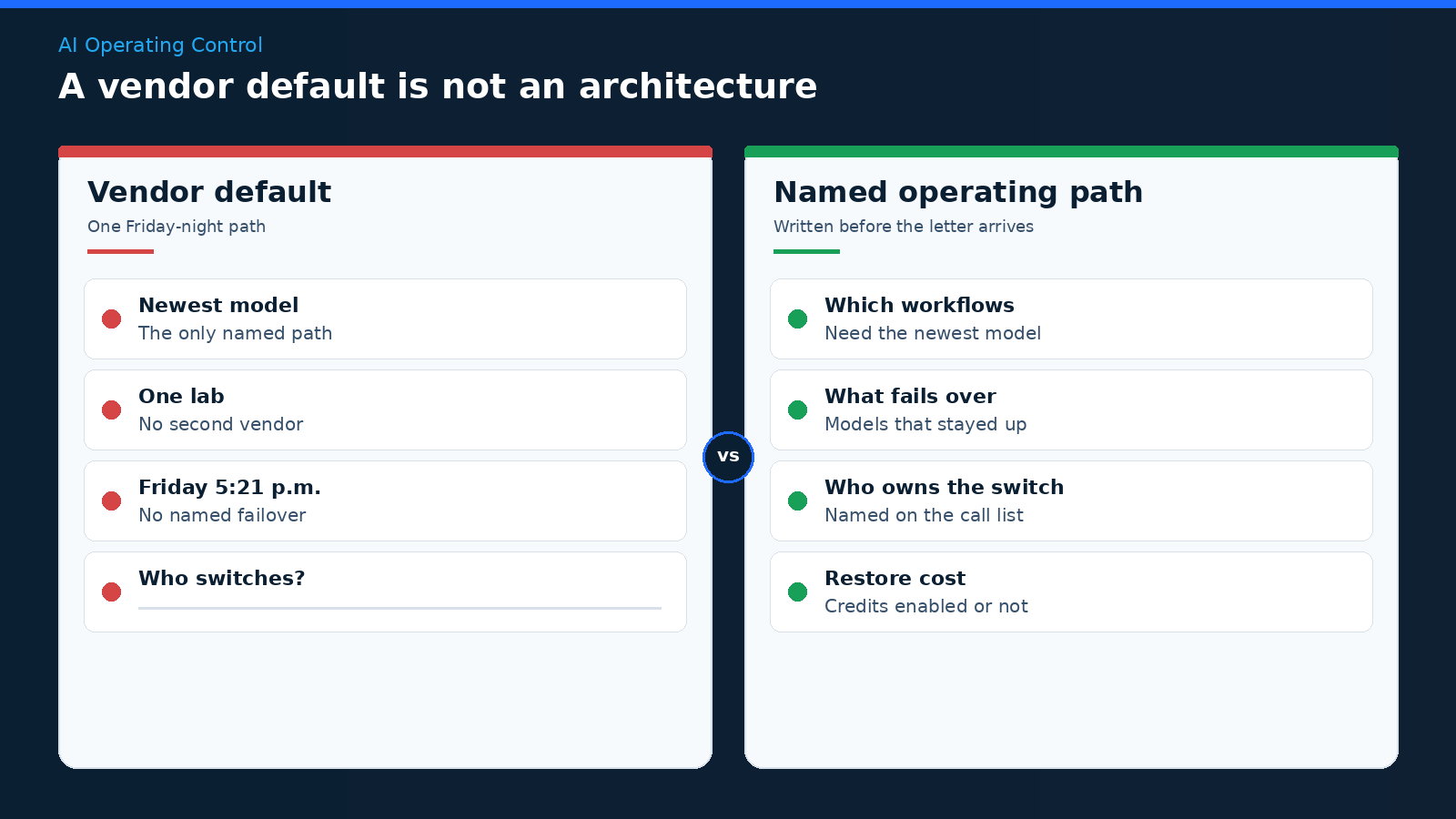
The business problem is not that a lab complied with a government letter. Labs will do that again. The business problem is that many organizations had already let the newest model become the path work takes, without naming what happens when that path closes.
Unmanaged dependence is what you have when one vendor, one model generation, and one Friday-night availability assumption are doing the job of an operating model. The work that follows is AI Operating Control: knowing what AI is being used, where the work is going, what it costs, what data is exposed, and how usage is governed, including which vendor you can leave when the model is gone.
The first phase of AI adoption was about access. The next phase is about control. Access looked like getting Fable 5 onto the approved list. Control looks like a written answer: if this model is disabled at 5:21 p.m. on a Friday, which work stops, which work moves, and who is allowed to move it.
Anthropic said its other models remained available. That helps only if someone had already decided which workflows may use the newest model and which must run on the models that stay up. A hypothetical, not a case study: legal, operations, and a supervisor of elections’ office all point at the same flagship SKU because it is the default. The outage is then one architecture failure with three symptoms.
Routing is the practical move. Reserve the newest model for work that actually needs it. Keep a named failover on models that were not in the letter. Vendor choice is the strategic move. Multi-cloud checkboxes do not create choice if every checkbox still calls the same lab. Choice means a second path tested on the real workflow, with the real data boundaries, by the people who would have to use it on a Friday night.
What should already be answerable on the next Friday night
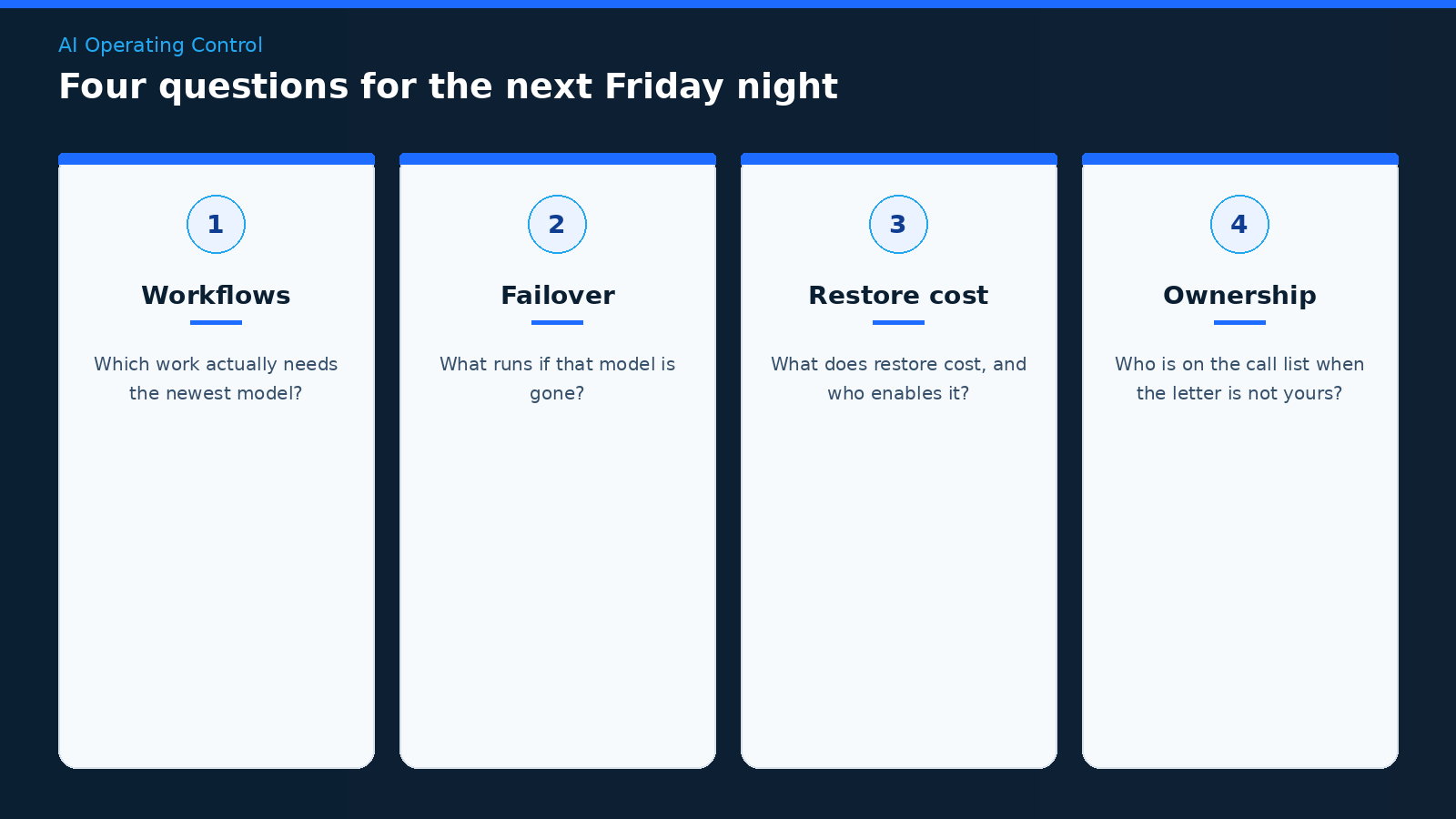
Four questions tell whether the June sequence taught the organization anything.
Which workflows actually require the newest model? If the answer is “whatever the assistant is set to,” there is no routing rule. Write the list by function: finance close, records requests, constituent correspondence, code generation, help-desk drafts. If a workflow cannot name a model, it cannot name a failover.
What runs if that model is gone? Other Anthropic models stayed up. That is a failover only if the work has already been pointed there, with permissions and data rules that still apply. A login that still works is not a continuity plan.
What does restore cost, and who enables it? Anthropic’s own terms put many enterprise seats on usage credits, with no included Fable 5 allowance on standard Enterprise seats unless credits were on. If credits are an afterthought, restore can look like availability while behaving like a dark SKU.
Who is on the call list when the letter is not your letter? CIO, county IT, counsel, and the vendor account team are different people. If the only person who noticed on 12 June was a developer watching an API error, the organization has a chat window, not operational ownership.
Those questions are for Florida counties, cities, and constitutional officers, and for a mid-sized company’s CIO, counsel, finance lead, and operations head. This desk is not counting how many shops were on the newest models.
What this does not settle
This is not legal advice on export controls, licensing, or how a public agency should classify staff nationality. Counsel owns that. The operating facts in the record are the 5:21 p.m. ET letter on 12 June, the global disable, the 30 June lift, and the 1 July restore.
This is not a finding that the government was right, or that Anthropic “misunderstood.” Anthropic used that word. This is not a claim about how many enterprises went dark, how Florida agencies fared, how effective any safety classifier was, or how long cloud channels lagged. Those numbers are not in the sources this piece relies on, and they are not invented here.
Buildtelligence does not sell a failover guarantee, a staffing plan, a timeline, or an SLA as a fact of this article. Engagements are scoped. A second vendor on a slide is not the same as a second path in production.
Buildtelligence helps companies use AI without losing control of cost, data, workflows, or vendor choice. It implements whatever stack the engagement requires. ThinkFreely is not a condition of hiring the firm, and this desk does not pretend a partner network exists around it.
The next question is whether you can switch
The open question is not whether Anthropic is a serious lab. It is. The open question is whether your operating model still assumes that the newest model will be there on Monday because it was there on Thursday.
If Washington can take that model offline on a Friday night, and you have no tested second path, you do not have a vendor. You have a single point of failure. The decision is whether to keep it that way.