
AI Skills
Turn Your Best Work Into Governed, Repeatable AI Skills
AI skills help companies turn useful AI practices and critical human expertise into repeatable, governed business capabilities. Many employees can create helpful prompts or informal workflows, but those efforts do not automatically become repeatable AI skills the organization can trust. Buildtelligence helps mid-sized companies extract knowledge from executives, managers, subject-matter experts, and key employees, then formalize that knowledge into AI skills that preserve instructions, support governance, route work appropriately, and make high-value tasks easier to repeat across teams.
What is an AI skill versus a prompt? Can AI skills capture executive knowledge?
What AI Skills Are
AI skills are structured, reusable systems for getting specific work done with AI. They are more than prompts. A skill can include instructions, context, source materials, examples, output requirements, review steps, governance rules, routing expectations, privacy boundaries, and workflow requirements.
A prompt helps an individual ask for something. A skill helps an organization repeat something.
Companies often find that a few employees become very effective with AI, but the value remains trapped in personal habits. AI skills help convert individual know-how into repeatable team capability.
Extracting Human Expertise Into AI Skills
Some of the most valuable AI skills begin as human skills. In many companies, critical operating knowledge lives in executives, managers, senior operators, subject-matter experts, and long-tenured team members.
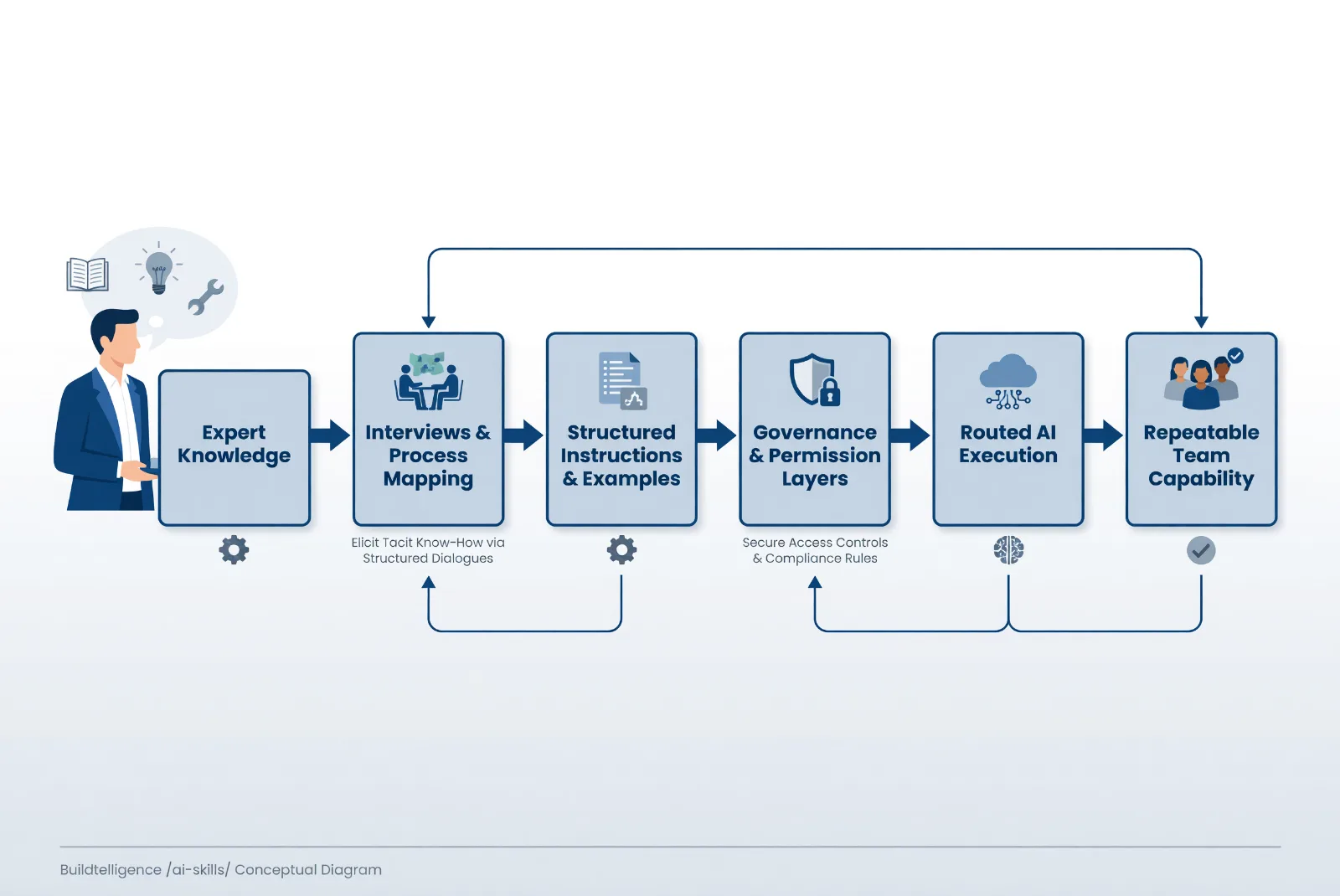
From Tacit Knowledge to Structured Instructions
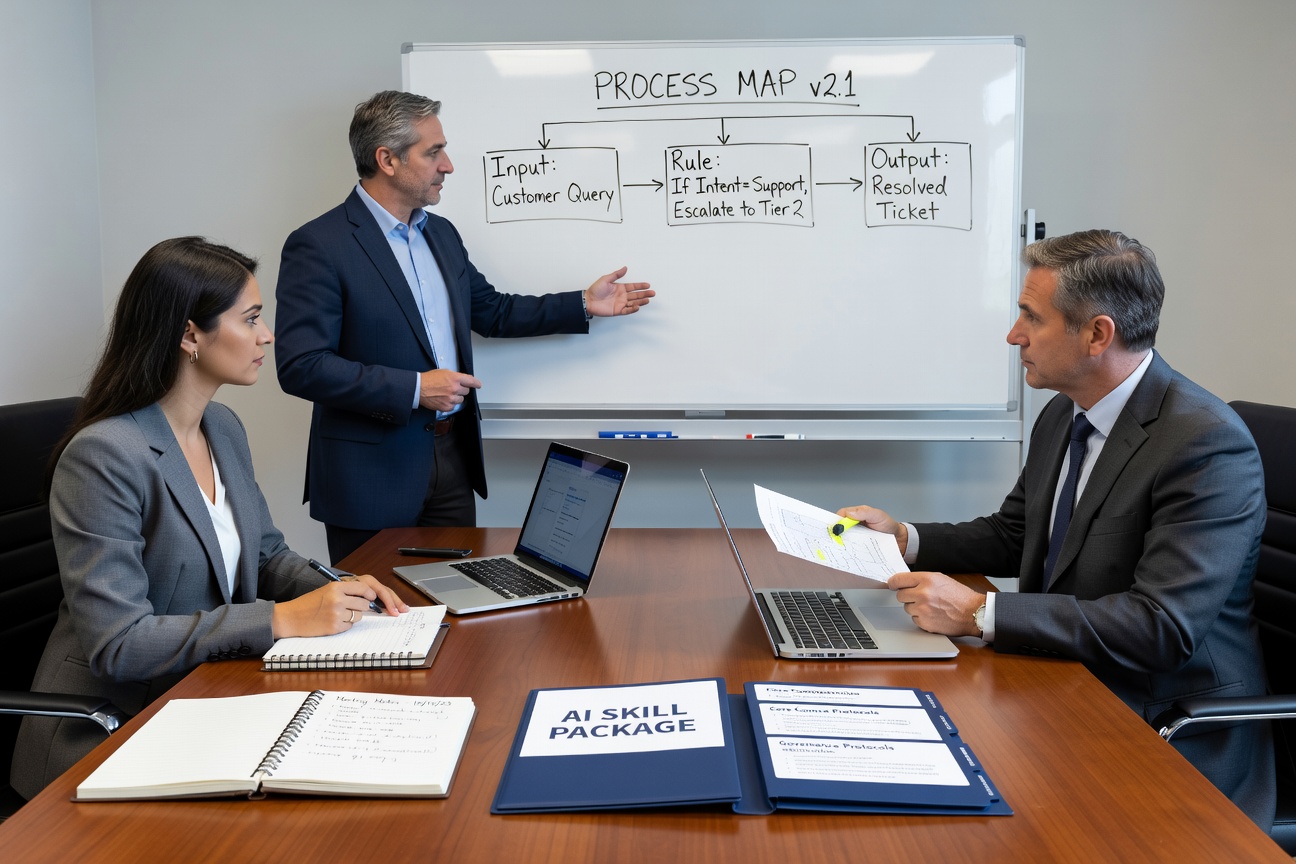
People know what to do but may not have written down how they know it. A manager knows when a client issue needs escalation. A senior salesperson recognizes a bad-fit prospect within minutes. We turn that tacit knowledge into structured AI instructions, examples, review rules, and output expectations.
From Individual Bottleneck to Shared Capability
When critical knowledge lives only inside key people, the organization becomes dependent on their constant availability. AI skills can help reduce that bottleneck. The human expert still validates the skill, refines examples, approves boundaries, and reviews outputs.
From Expert Interviews to Skill Packages
Skill packages include role and task instructions, decision rules, examples and counterexamples, approved language, escalation criteria, review requirements, output formats, quality standards, governance boundaries, and source material references.
Why AI Skills Need More Than Prompts
Prompts can be powerful, but prompts alone usually do not scale well across a business. A prompt may work for the person who wrote it because that person understands the context. Another employee may copy the same prompt and get weaker results because the surrounding process is missing.
- Instructions are incomplete or inconsistent
- Employees use different source material
- Outputs vary by person, model, or session
- Review expectations are unclear
- Sensitive information may be used without guidance
- Successful prompts are not documented or improved
- Workflows depend on individual judgment instead of shared structure
- Applications may embed prompt logic that is hard to update later
- Skills may be tied to one model provider even when the work does not require it
- Critical employee knowledge remains informal and unavailable to the broader team
An AI skill gives the prompt a workflow, governance model, routing path, operating context, and human expertise layer around it.
ThinkFreely and Skill Control
ThinkFreely expands the meaning of an AI skill beyond a saved prompt or custom assistant. With ThinkFreely, a skill can be treated as a persistent, governed instruction layer maintained by the AI Operating Layer rather than repeatedly rebuilt inside every application request.
AI experimentation can run on prompts. AI operations need skill control.
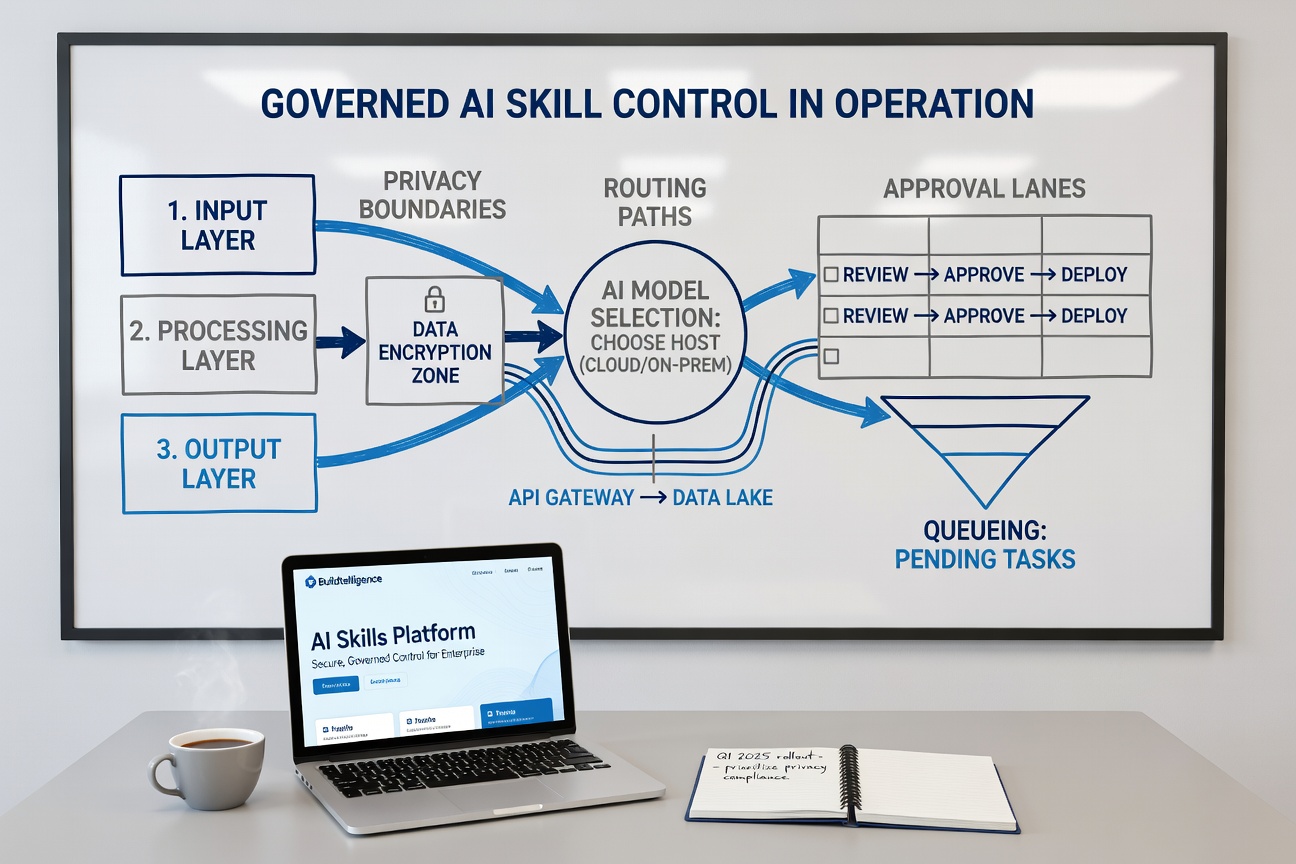
Skill control is the discipline of defining, persisting, routing, permissioning, and governing AI skills as operating-layer capabilities. Not every AI skill requires ThinkFreely, but it becomes valuable when skills need persistent instructions, routing, permissions, privacy controls, and operational visibility.
- Skill instruction persistence
- Layered governance, security, brand, skill, task, and temporary instruction blocks
- Token-gated skill mutation
- Model and host routing
- Privacy-aware pre-routing
- Priority-aware queueing, failover, and retry
- Application decoupling from prompt persistence logic
- Operational history and diagnostics
DriftHold, RouteFreely, and Layered Instruction Control
DriftHold turns skill control into an application-facing capability. Instead of every application rebuilding the full prompt package on every request, DriftHold allows an authorized application to declare instruction state that should persist until changed, appended, stopped, or replaced.
The application declares the skill state. ThinkFreely maintains it. RouteFreely routes the request. DriftHold keeps the instructions from drifting.
Skill behavior operates inside layered context: platform instructions, governance instructions, security instructions, tenant or workspace instructions, brand or voice instructions, skill instructions, task or session instructions, temporary instructions, and the current user prompt. Different layers have different owners and lifecycles. Governance and security instructions should usually persist with strict mutation control. Brand instructions may persist across a workspace. Task instructions may persist only for a project or session.
Gateway Contracts and Output Contracts
As skills become part of real work, they need boundaries. A ThinkFreely skill can be governed by a gateway contract and an output contract.
Gateway Contracts
A gateway contract defines how a skill request is allowed to move through the AI operating layer. Which model classes are allowed, which host types, whether strict routing applies, capability requirements, local versus remote allowances, privacy outcomes, fail-closed behavior, priority lanes, fallback hosts, and which token is authorized.
Gateway contracts control where the skill can go.
Output Contracts
An output contract defines what the skill is expected to return. Required structure, required fields, prohibited outputs, escalation behavior, review requirements, tone, and formatting. Examples include returning structured summaries, including escalation flags when legal risk is detected, never authorizing refunds, and asking for missing inputs.
Output contracts control what the skill is expected to return.
Application Decoupling and Lighter Deployments
Skills do not have to live inside the deployed application. They can live in approved skill packages or scoped file registries, then be referenced dynamically by an authorized application when needed. Skill packages, brand voice files, governance layers, task instructions, or workflow rule sets can be updated centrally without forcing every application to be rebuilt and redeployed.
The application sends the task and authorized token. ThinkFreely manages the persistent skill state and AI operating logic.
This can make deployed applications lighter. When instruction persistence, skill files, routing rules, provider differences, privacy policies, fallback logic, and skill state move into ThinkFreely, the application no longer needs to carry the full weight of AI orchestration. This matters for mobile apps, tablets, field-service devices, kiosks, browser-based apps, CRM widgets, customer portals, and edge-adjacent workflows.
Examples of AI Skills
The strongest AI skills usually involve repeatable work that depends on knowledge, judgment, structure, or documentation.
Executive Judgment
Extracts complex prioritization, risk, or communication decisions through interviews and scenario review, then translates them into a structured skill that supports leadership workflows or management training.
Management Escalation
Captures decision rules for when an issue should stay frontline, escalate to leadership, or route to legal review. Flags escalation conditions and asks for missing context.
Support Ticket Triage
Summarizes, classifies, and routes support tickets. Output contract requires summary, issue type, urgency, sentiment, recommended department, and escalation flag. Skill boundary prevents refund approval.
Brand Voice Writer
Preserves an approved style across long sessions. RouteFreely routes routine drafts to efficient models and high-value strategy pages to stronger models. Skill boundary prevents unsupported claims.
Executive Briefing
Defines source material, summary structure, level of detail, tone, and risks to flag. Reduces manual effort while preserving leadership-level usefulness.
Internal Knowledge
Connects approved knowledge sources to repeatable workflows. Faster access to useful knowledge while maintaining boundaries around source materials and review expectations.
When You Need This
- Useful AI practices exist but are not repeatable across the organization
- Outputs are inconsistent, prompts are shared informally, valuable workflows depend too heavily on individual users
- Work needs to follow a defined process, use approved source material, and meet quality standards
- Critical expertise is concentrated in a small number of executives, managers, or key employees
- Tone, privacy, or instruction stability must be preserved over time
When This Is Not the Right Fit
Not the right fit if the company has not yet identified a meaningful workflow or repeatable task, or if the work changes too much from case to case to translate into a usable process.
For broader process design, AI workflow implementation may be the better starting point. AI workflow implementation defines the broader process; AI skills define the repeatable AI-supported task behavior inside that process.
Frequently Asked Questions
What are AI skills?
AI skills are structured, reusable systems that help teams complete specific tasks with AI. They can include prompts, instructions, source materials, output requirements, review steps, governance rules, routing expectations, and workflow context.
How are AI skills different from prompts?
Prompts help individuals ask AI for something. skills help organizations repeat a process. A skill includes the prompt, but also the surrounding workflow, context, governance, output standards, routing expectations, and review requirements.
Can Buildtelligence turn employee expertise into skills?
Yes. Buildtelligence can help extract critical knowledge from executives, managers, subject-matter experts, senior operators, and key employees, then translate that knowledge into structured skills with instructions, examples, decision rules, review requirements, and governance boundaries.
Do skills replace executives or key employees?
No. skills are designed to preserve, structure, and support the use of critical human expertise. They can reduce bottlenecks and improve consistency, but key employees remain important for validation, oversight, exception handling, and refinement.
How does ThinkFreely change skills?
ThinkFreely can turn skills into governed operating-layer capabilities. With DriftHold, skill instructions can persist across model calls. With RouteFreely, skill requests can route based on capability, priority, privacy, host availability, and failover rules.
What is skill control?
Skill control is the discipline of defining, persisting, routing, permissioning, and governing skills as operating-layer capabilities. It helps companies manage which instructions persist, who can change them, where requests route, and what behavior the skill should maintain.
Do skills require ThinkFreely?
Not always. Some skills can operate inside existing tools and workflows. ThinkFreely may be recommended when the company needs persistent instruction state, token-gated skill control, stronger visibility, privacy control, model routing, workflow governance, or instruction stability.
Can skills run on different models?
Yes, when routed through ThinkFreely. DriftHold can preserve the skill instructions while RouteFreely routes the request to compatible models or hosts based on capability, priority, privacy, and availability.
What are gateway contracts and output contracts?
Gateway contracts control where the skill can go, including model class, host type, privacy outcome, priority lane, and token authority. Output contracts define what the skill is expected to return, such as structure, fields, tone, escalation flags, prohibited outputs, and review requirements.
Can skills be updated without changing the application?
Yes, in a ThinkFreely skill-control pattern, authorized applications can reference skill state or approved skill files managed outside the deployed application. Skill behavior can be updated centrally.
How do skills connect to AI workflow implementation?
skills are often part of AI workflow implementation. They define how specific AI-supported tasks should operate inside a broader workflow, including instructions, outputs, review, routing, privacy handling, and governance.
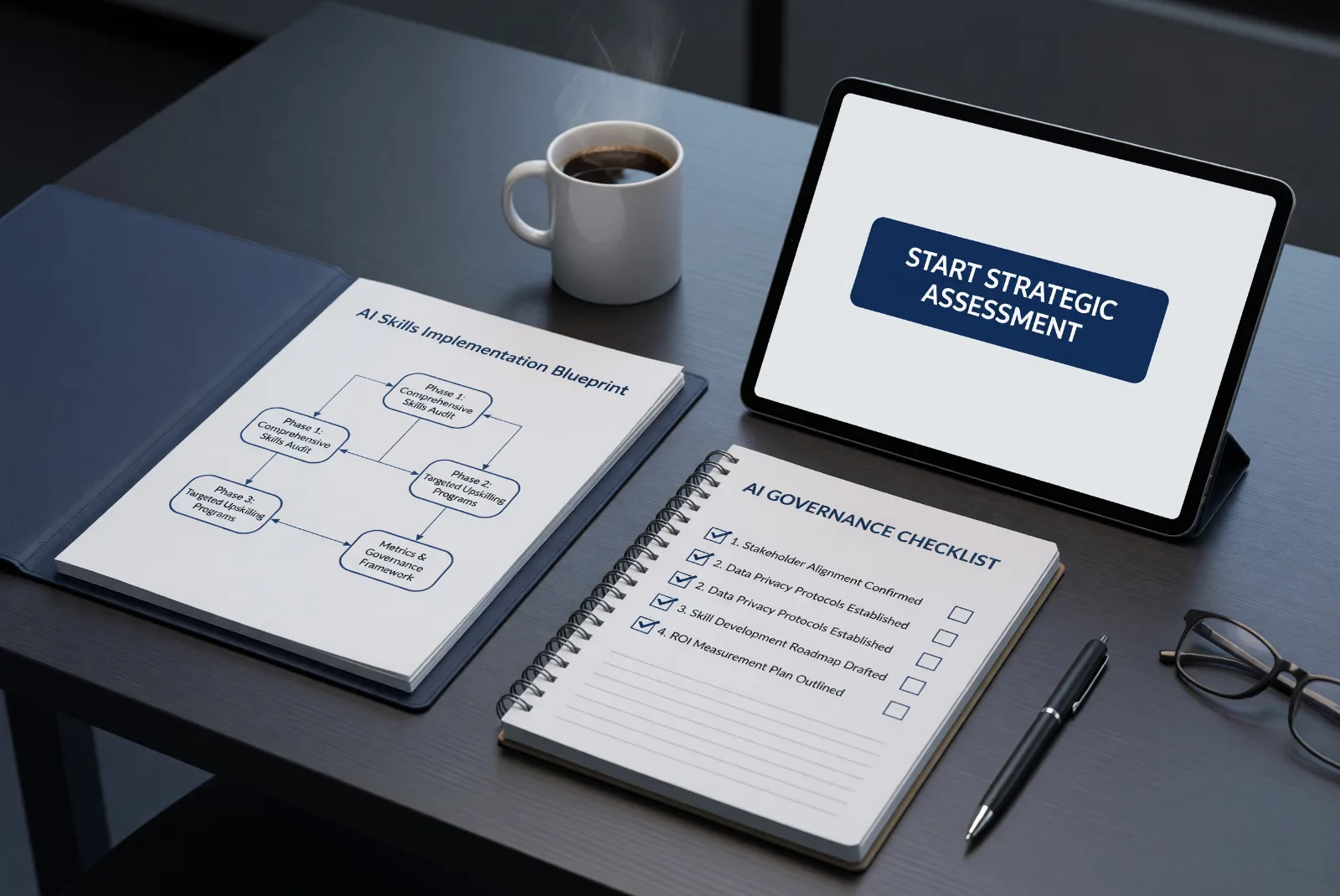
Turn Human Expertise Into Governed AI Capability
skills help companies move beyond individual experimentation. Buildtelligence helps identify the work worth repeating, extract critical human knowledge, structure the instructions, define the review process, and create governed skills that teams can actually use.